← All talks

Talk 02 — Review

“How Crack-headed Salmon Influence the Dynamics between Human and the Environment”

Rayang T Mendrofa - 23rd January 2026

So apparently, it’s not enough that coke (not the soda) wrecks human brains and societies, it’s now moonlighting as an aquatic travel agent for salmon. Yes, you read that right: our wastewater is basically giving fish a chemical pep talk, sending them swimming farther and faster like they’ve signed up for some underwater marathon. Why is it relevant? Because it’s a perfect reminder that human habits don’t politely stay confined to humans. They leak—literally—into rivers, lakes, and ecosystems, turning wildlife into unwilling participants in our chemical experiments. If salmon are suddenly dispersing differently thanks to our recreational choices, imagine what that says about the invisible ways pollution might be nudging human communities too. While this paper particularly delved into the further end of “recreational” means. This gives us an opportunity to study the case.

Chart A — From drain to lake

How much cocaine ends up in the water?

Nanograms per litre (a nanogram is a billionth of a gram). Each step on the scale is ten times bigger than the last. The leftover compound your body makes, benzoylecgonine, usually outnumbers cocaine itself.

Wastewater going into riversAustralia, highest measured
2,990
21,570
Rivers & lakes worldwideaverage across studies
105
257
British salmon rivershighest measured
17.4
72.4
Lake Vättern, study sitetrace amounts
0.85
1.05
0.11101001,00010,000100,000

ng per litre, log scale

Cocaine Benzoylecgonine (metabolite)

01

What’s in the paper?

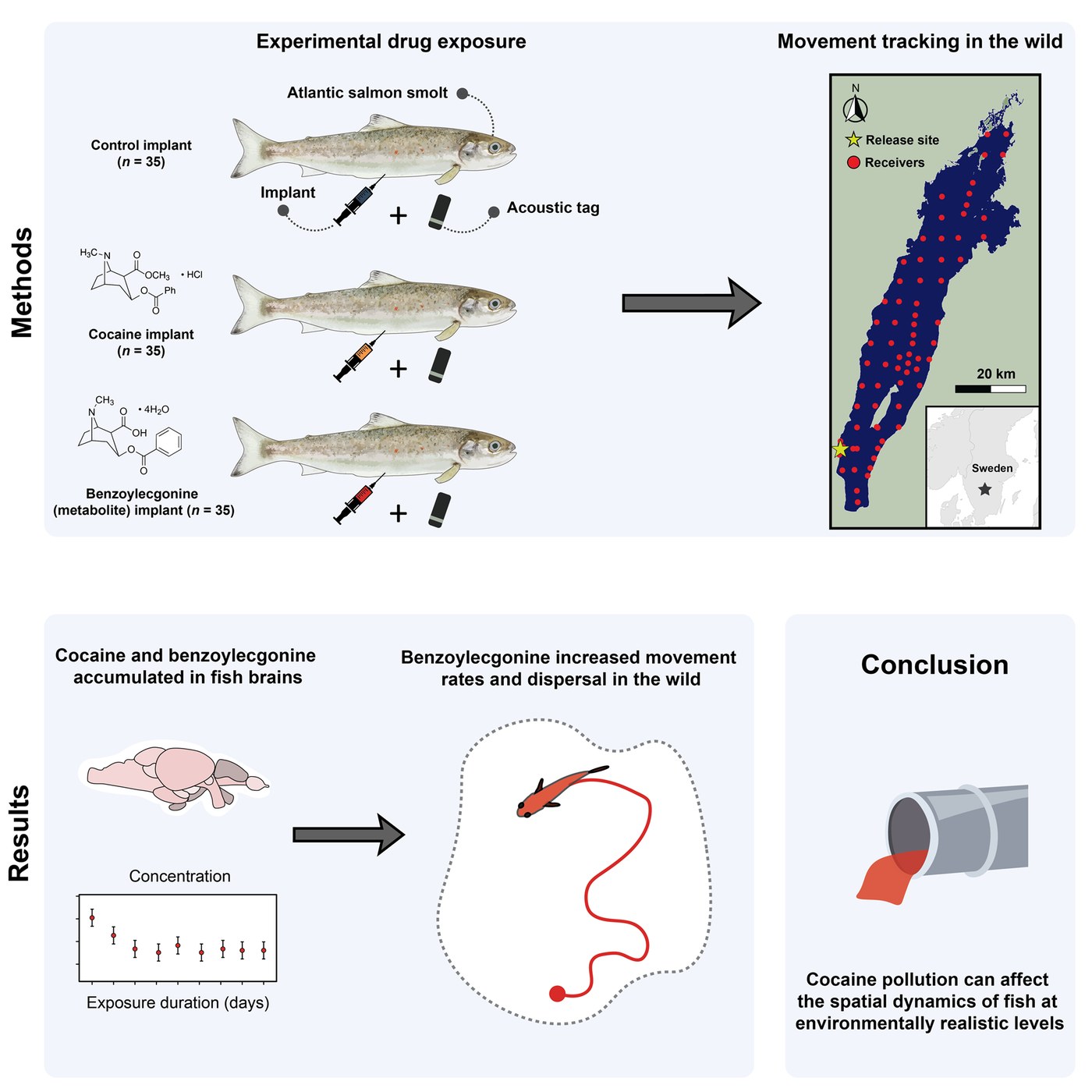
Salmon, a fish that is commonly known for its delicacy and taste in human flavour palette. The study is a behavioral analysis of this particular species in Lake Vättern. The authors of this paper assigned salmon smolts that were implanted with slow-release cocaine or benzoylecgonine, then tracked in Lake Vättern using acoustic telemetry.

These fishes are tagged and monitored to determine the effects of drug exposure in their behavior such as weekly movements, maximum dispersal distance relative to release site, and their space use across the lake.

105

Young salmon (smolts), split into three groups of 35.

71

Underwater listening stations spread across the lake.

1,912 km²

Lake Vättern, Sweden’s second-largest lake.

8 weeks

Of tracking used for the movement results.

“Subject” Salmon

Salmo salar

Atlantic salmon (Salmo salar) were selected because they are both ecologically and economically important species that have already suffered major population declines due to human‑driven environmental changes. Their migratory life cycle makes them especially sensitive to pollutants, since they depend on clean rivers and lakes during critical stages of development. By choosing salmon smolts, the researchers could test how drug pollution affects a species that not only plays a key role in aquatic ecosystems but also supports fisheries, conservation programs, and cultural heritage.
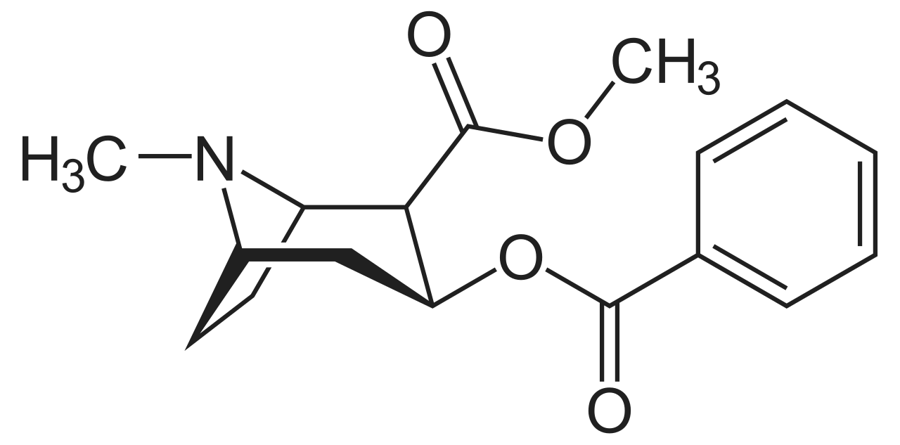
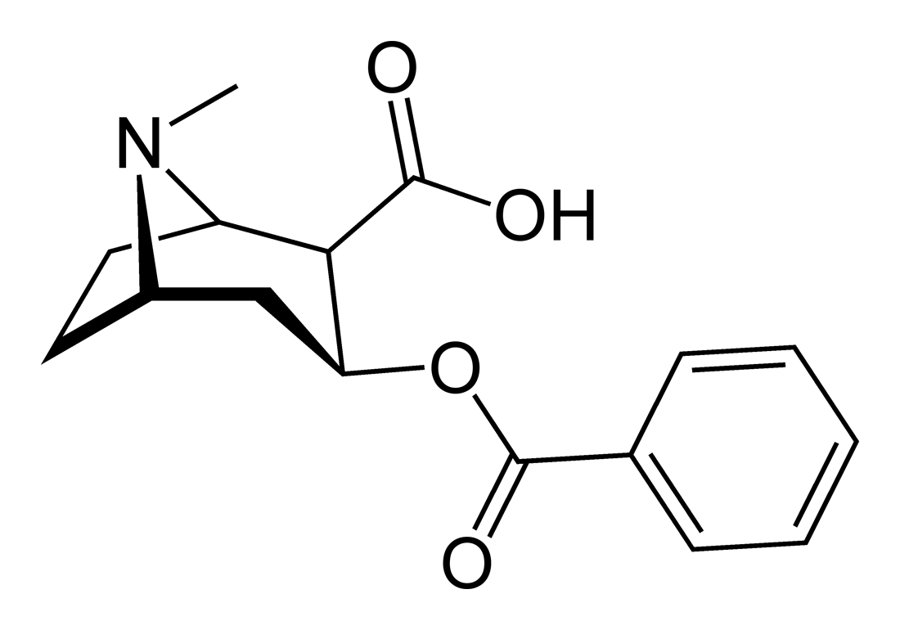
Chemicals “Factor”

2 compounds
Chemical structure of cocaineCocaine
body breaks it down
→
Chemical structure of benzoylecgonineBenzoylecgonine

Cocaine wasn’t picked at random, it’s one of the most widespread illicit pollutants in rivers and lakes, stubbornly slipping past wastewater treatment. In regions like Sweden and the UK, cocaine and its metabolite benzoylecgonine have been detected in wastewater effluent and river systems that overlap with salmon habitats, meaning these fish are directly at risk of exposure. Its ability to hijack dopamine pathways means it doesn’t just mess with humans; it tweaks fish brains too. That makes it the perfect candidate to show how our recreational choices ripple into ecosystems.

02

So, how did they do it?

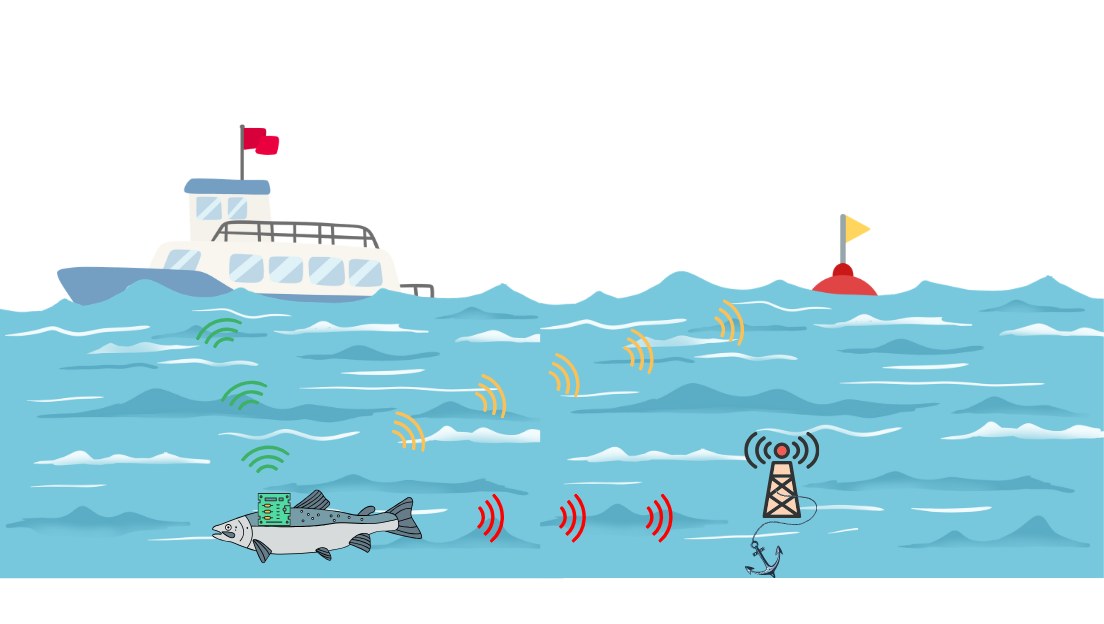
Acoustic Telemetry is digital tracking using soundwaves as medium to determine location of subject of research.

Acoustic tags are small devices that contain a battery, microchip, and transducer, each programmed to emit a unique acoustic signal or “ping.” The size of the tag depends on the species being studied and the desired battery life. The frequency and rate of these pings determine how long the tag can function, balancing detection range with energy use. They are either attached or implanted inside the specimens.

Illustration: a tagged salmon sends sound pings through the water to an anchored receiver, with a research boat and a marker buoy on the surface
How the tracking works

Each fish carries a tag that pings. Receivers anchored around the lake hear the pings and log which fish passed by and when. Join the dots and you get each fish’s route.

Paper graphical abstract: three groups of salmon smolts get a control, cocaine or benzoylecgonine implant plus an acoustic tag, then are tracked across Lake Vättern; results show the drugs in fish brains and wider movement

The experiment in five steps

  1. 1Each young salmon got a small acoustic tag plus a slow-release implant: plain coconut oil, cocaine, or benzoylecgonine.
  2. 2The fish rested for 3–4 days to recover.
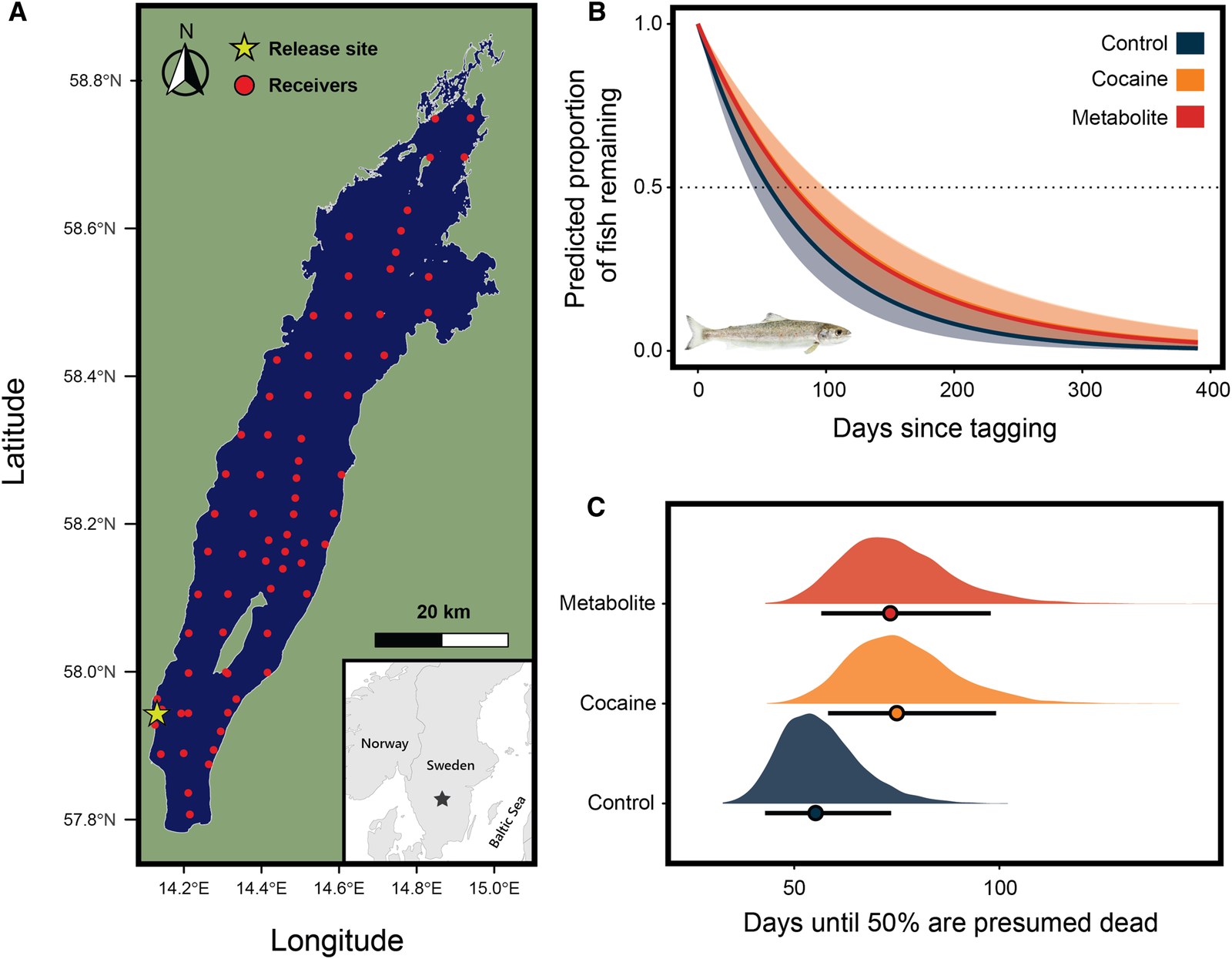
  3. 3On 12 April 2022, all 105 were released together in the south-west of Lake Vättern, alongside 200 untagged fish to spread out the predators’ attention.
  4. 471 receivers listened for their pings across the lake.
  5. 5A separate group of 63 fish stayed in tanks to check how much drug actually reached their brains.

03

What did they find?

01

Restless swimmers

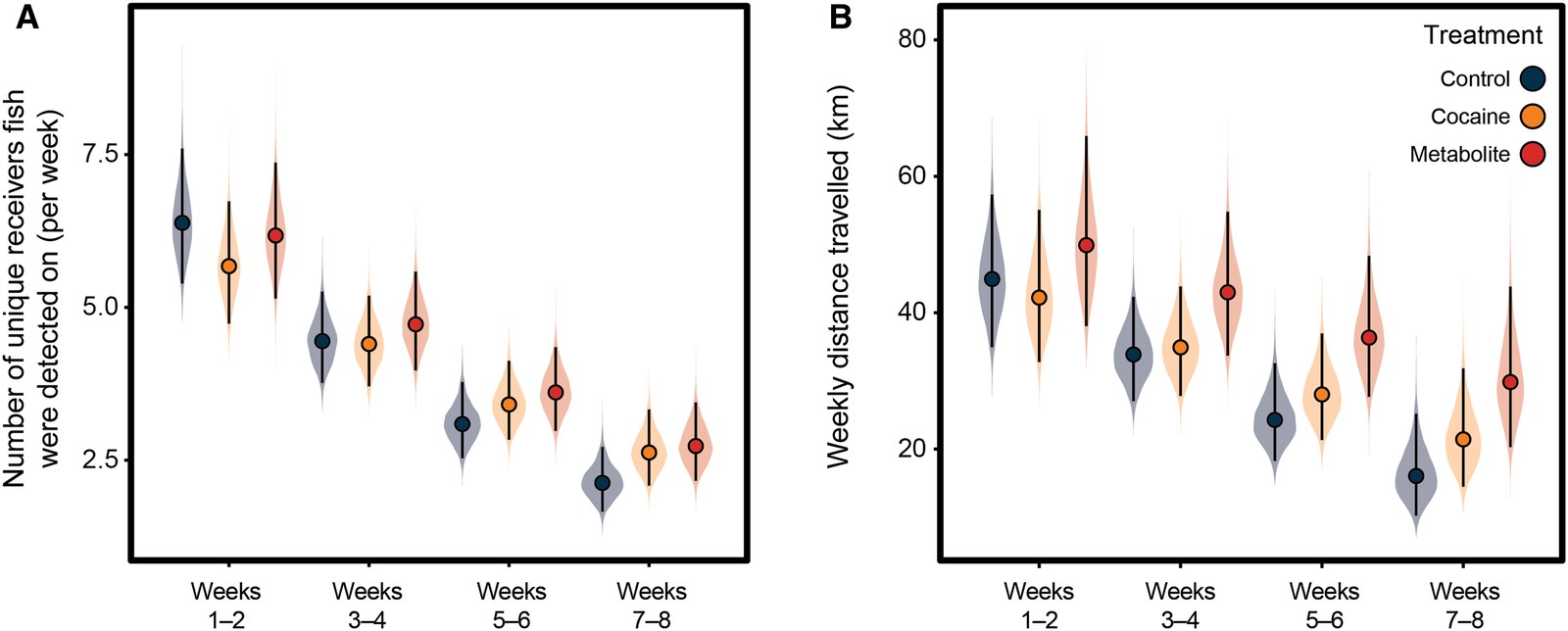
Fish given benzoylecgonine swam up to 1.9× farther per week than untreated fish.

02

Farther from home

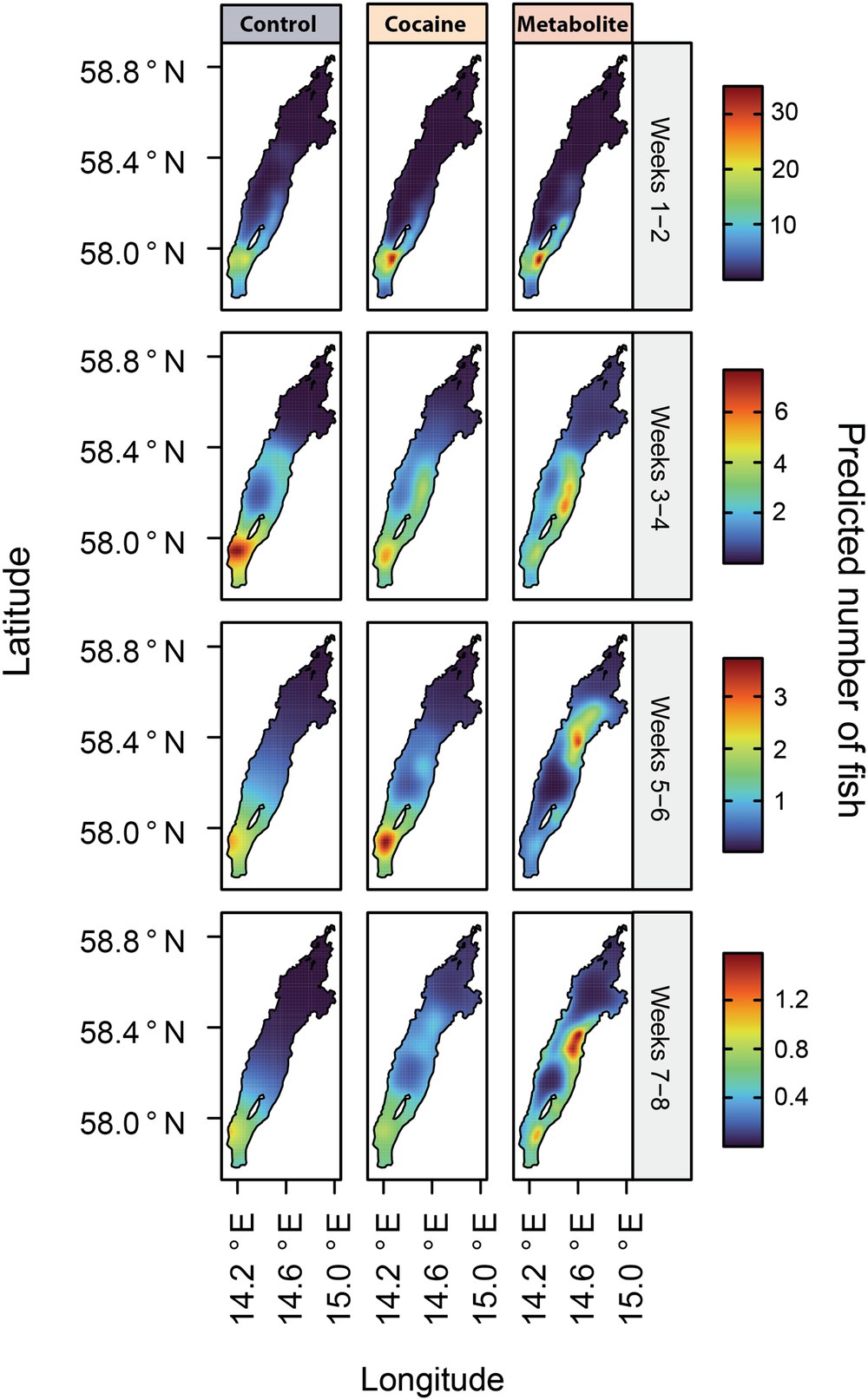
They ended up as much as 12.3 km farther from where they were released.

03

The leftover matters most

Cocaine itself nudged movement the same way, but the effect was weaker and less certain.

04

Not clearly deadlier

There was no clear difference in how long the fish survived.

Chart B — Try it: week by week

How far did each group swim per week?

Pick a fortnight. All the fish slow down as they settle into the lake, but the untreated fish slow down the most.

Control
16 km
Cocaine
21.3 km
Metabolite
29.7 km

Kilometres per week (scale to 60 km)

Metabolite vs control1.9× farther
Extra distance per week+13.7 km

By the end, benzoylecgonine fish swim almost twice as far (about 14 km more per week). Cocaine fish swim about 5 km more, but that estimate is uncertain.

Control (no drug) Cocaine Metabolite (benzoylecgonine)
Chart C — Wandering off

How much farther from home did they get?

Change in each group’s farthest distance from the release point over the 8 weeks. Dot = best estimate, line = likely range.

Control
Cocaine
Metabolite
-5 km0+5 km+10 km+15 km+20 km
Chart D — Did it harm them?

Days until half of each group went quiet

Not clearly. The drug groups lasted a little longer, but the ranges overlap a lot.

Control
Cocaine
Metabolite
40 days60 days80 days100 days

04

It matters? How?

Atlantic salmon are already in decline, and how a young salmon moves decides where it feeds, which predators it meets and whether it makes it to adulthood. To the authors’ knowledge, this is the first time a cocaine-related pollutant has been shown to change fish behaviour in the wild rather than in a lab tank.

The twist is that the leftover compound, benzoylecgonine, had the bigger effect. It is usually found at higher levels in water than cocaine, yet risk checks for drugs in the environment often focus on the original compound. So the problem isn’t only what we take; it’s what we flush away, and what treatment plants can’t catch.

Worth keeping in mind: these were hatchery fish, the tracking only captures fairly large movements, and the lake itself was close to drug-free, so the doses came from implants set to realistic levels.

05

TLDR?

From your bathroom to the lake, in four steps...

  1. 1People use cocaine; the body turns most of it into benzoylecgonine.
  2. 2Treatment plants don’t catch it all, so both end up in rivers and lakes.
  3. 3Young salmon given realistic doses of the leftover compound swam farther and wandered farther from home.
  4. 4Moving differently changes where fish feed, hide and get eaten. A small chemical, a big ripple.

06

Personal Take

I’ll admit it: the title made me giggle. “Cocaine salmon” sounds like something from a meme page, not a peer-reviewed journal. I’m no serious angler, just someone who enjoys the occasional laid-back afternoon at a fishing pond, so my first thought was the obvious joke about which fish would put up the better fight.

But the more I read, the less it felt like a joke. This isn’t the kind of study you would ever think to ask for, yet it lands right on how we see the environment. The things we flush away don’t disappear; they end up in the same lakes and rivers where fish live. What surprised me most is that it wasn’t even cocaine itself but what is left after our bodies break it down that made the bigger difference, the part that hardly anyone tests for.

Even on my casual trips, you notice that fish move with purpose: where they feed, where they hide, when they decide to bite. If our habits can quietly redraw that map, then pollution isn’t only about dead fish floating on the surface; it is also about living fish behaving in ways nobody notices.

It’s also a fun one to bring up with friends, most of whom never say no to salmon sushi or sashimi. Atlantic salmon, the species in this study, is the same fish behind most of the salmon on a sushi plate. Nobody is saying their nigiri is spiked: the fish here were dosed on purpose for the experiment, and sushi salmon is mostly farmed far away from this lake. But it is a good reminder that the fish we love to eat share their water with whatever we wash down the drain.

I came for the laugh, and left seeing both the fishing pond and the sushi counter in a new light.

← Back to all talks
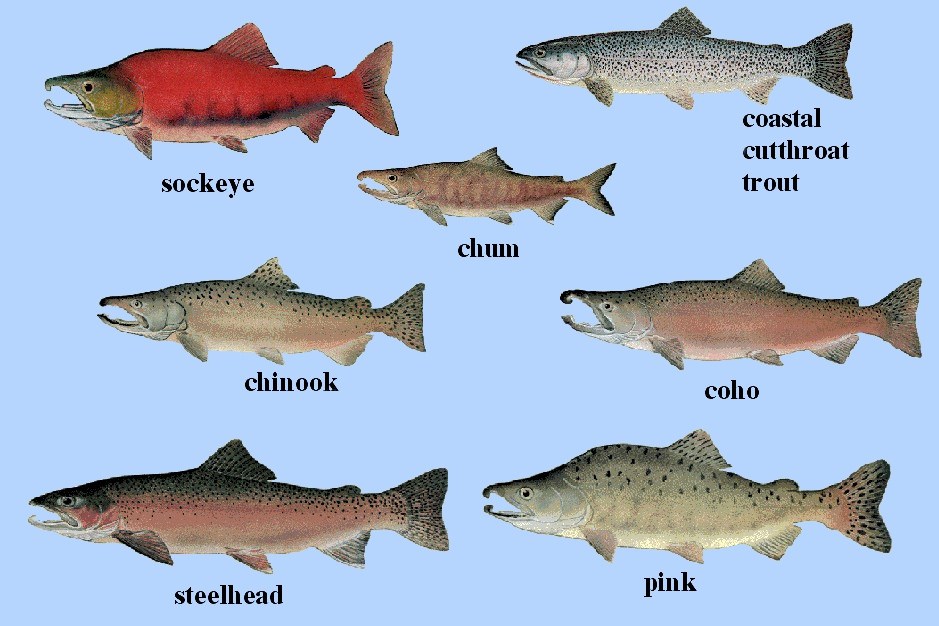
MY KIND OF FISHING: CASUAL, PATIENT, AND NOW AND THEN SUCCESSFUL.
Illustrated chart of salmon and trout species: sockeye, chum, coastal cutthroat trout, chinook, coho, steelhead and pink
A FIELD GUIDE FOR THE CASUAL FISHER: PACIFIC SALMON AND TROUT. THE STUDY’S FISH, ATLANTIC SALMON, IS THEIR COUSIN FROM THE OTHER OCEAN.

Discussion

Comments

No comments yet

Register with your email to join the discussion

Your email is never shown publicly.

No comments yet. Be the first to share your thoughts.