Talk 03 — Review
“When Necromancy is no longer locked in game and available in life Skill Trees”
When a spider dies, its legs curl inward. This is not rigor mortis in the conventional sense — it’s physics. A spider extends its legs not with muscles but with hydraulic pressure. Hemolymph fluid is pumped from a central chamber in the cephalothorax — the prosoma — into the leg joints. When the animal dies and the pressure drops, the legs retract to their resting state. Folded. Still.
A team of researchers at Rice University looked at a dead curled spider and saw something most people wouldn’t: a gripper that was already built.
A needle, a drop of superglue, about ten minutes.
Of its own mass: the heaviest thing it lifted.
Open-and-close cycles before wear set in.
Of useful life before the body dried out.
01
What’s in the paper?
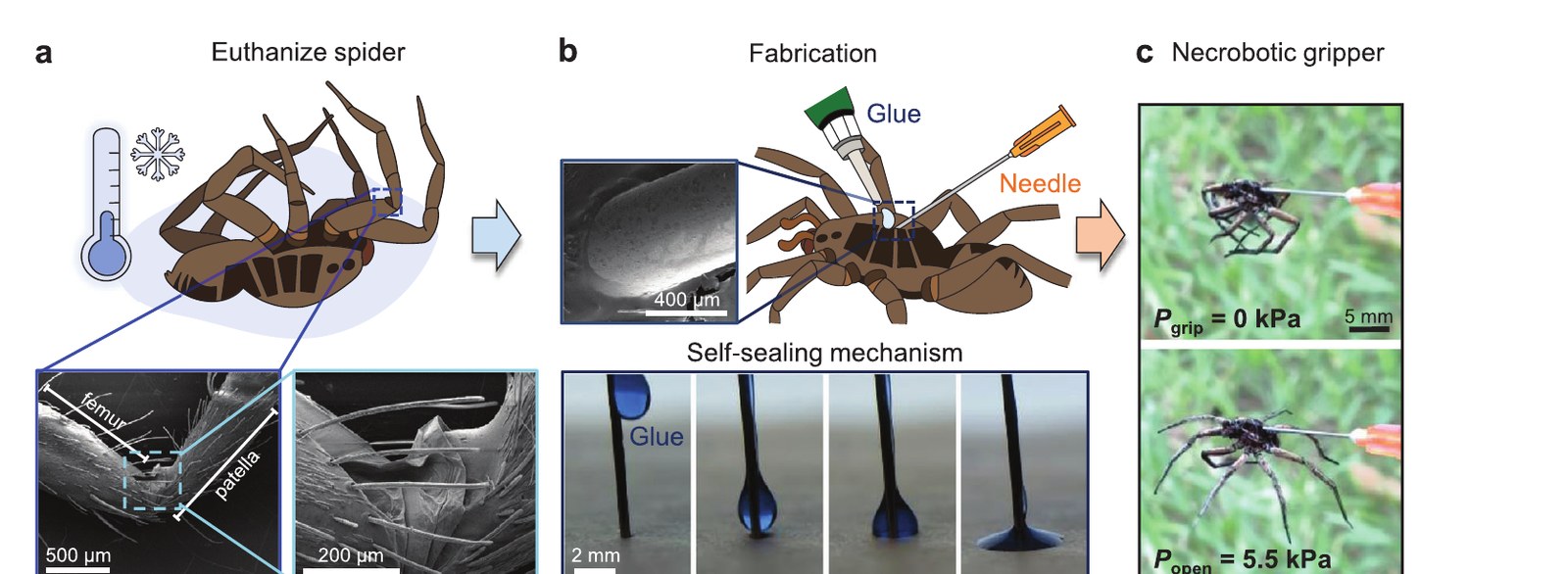
Their 2022 paper, Necrobotics: Biotic Materials as Ready-to-Use Actuators, describes what came next. They euthanised wolf spiders by cooling, inserted a 25-gauge hypodermic needle into the prosoma, and sealed the entry point with a drop of superglue. That’s the entire fabrication process. By pumping air through the needle, they could re-pressurise the hydraulic system — opening the legs on command, releasing them when the air pressure dropped. The spider grips. The spider releases. The spider, dead for however long, continues to do exactly what evolution designed it to do.
The naming of the field matters. Necrobotics is a deliberate coinage: biotic materials — non-living materials derived from living organisms — used as robotic components. The paper places this in a lineage going back to prehistory. Humans wore animal hides and used bones as tools long before they had words for materials science. What the researchers did isn’t categorically new. It is, however, a particular kind of acceleration: we have gone from wearing the animal to actuating it.
How to make one, in three steps
- 1Euthanise a wolf spider by cooling it (around −4 °C for 5–7 days).
- 2Insert a 25-gauge needle into the prosoma, the front body section where the legs attach.
- 3Add a drop of superglue. It slides down the needle and seals itself around the entry point in about ten minutes.
02
Why a spider?
What makes the spider useful here is precisely the feature that makes it unusual. Almost every vertebrate, and most other arthropods, extends limbs through opposing muscle pairs — one muscle pulls, another pushes back. The spider dispensed with the extensor side of that equation entirely, substituting a pressurised fluid system instead. This gives it a higher power density in a smaller space — more force relative to body mass — and the explosive movement capability that makes spiders effective hunters. Evolution solved a mechanical engineering problem in a way that engineers hadn’t seriously considered until they looked at the corpse.
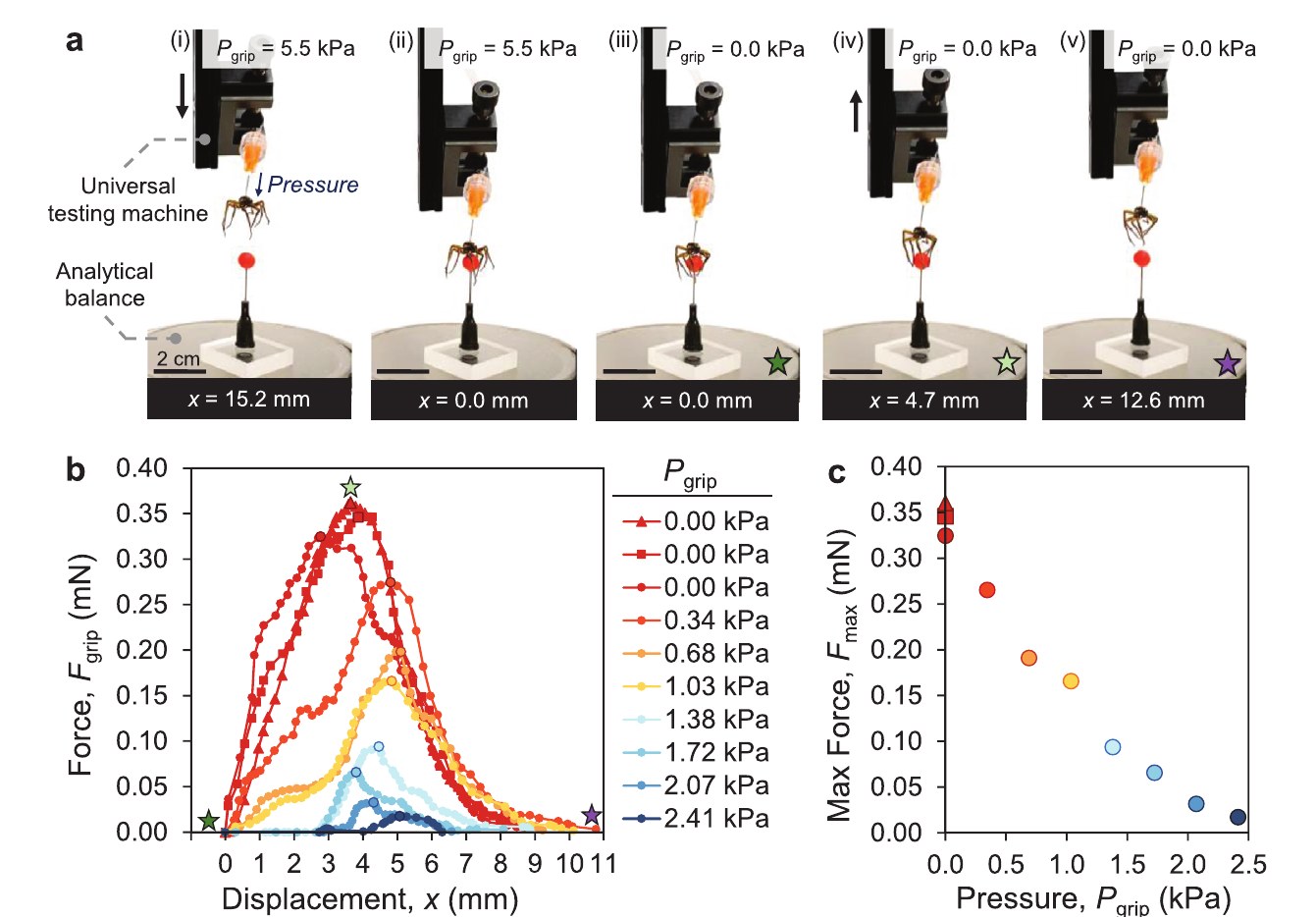
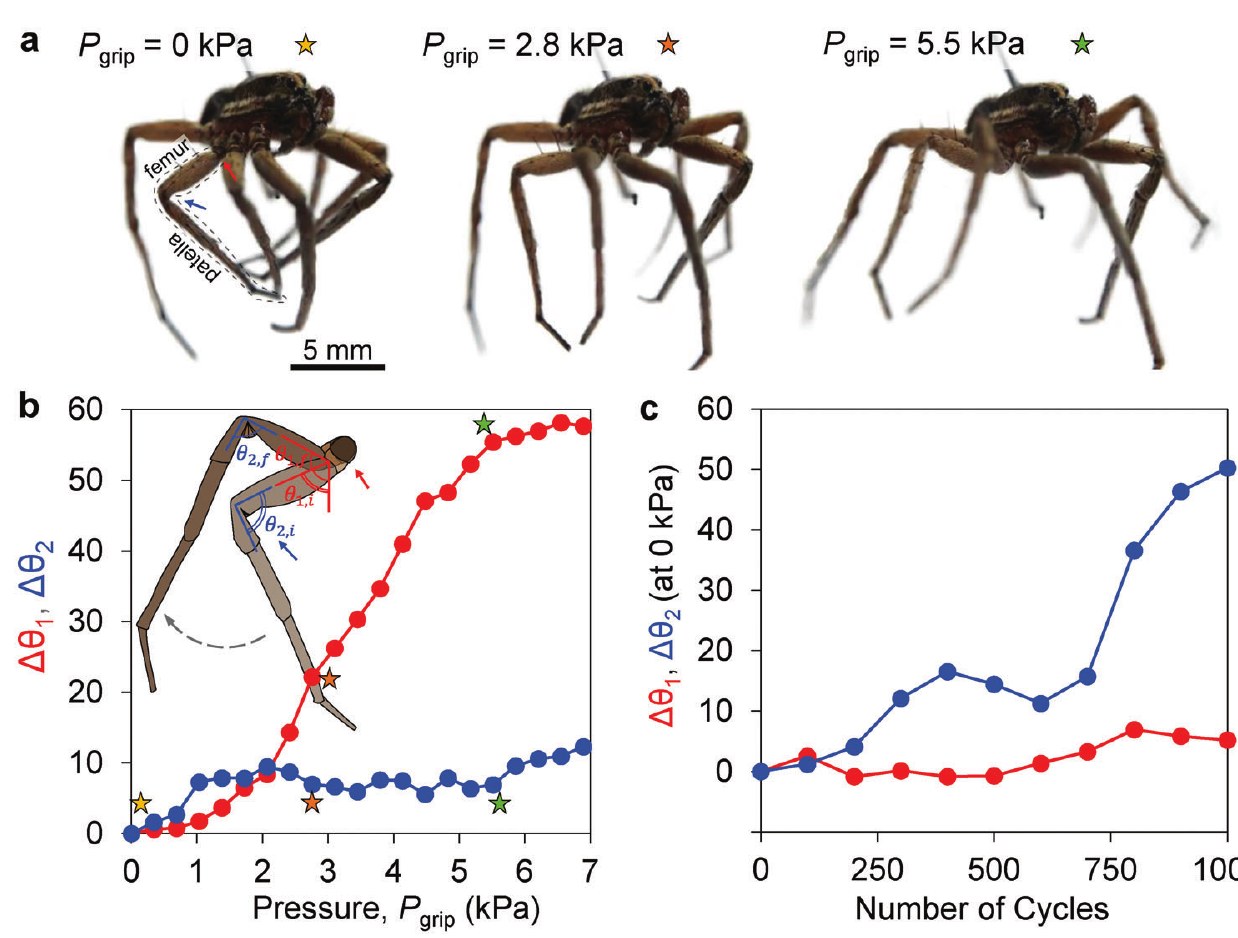
More pressure opens the legs; letting go makes it grip
Pick a pressure. With none, the legs curl shut and squeeze hardest. Add air and they swing open, and the grip fades away. A live spider’s legs sit at about 4–6 kPa.
No pressure: the legs curl shut and squeeze hardest. This is how the gripper holds on, with no power at all.

Energy use while gripping
Zero. Closed is the spider’s resting state, so once it has hold of something it just… stays there. Power is only needed to let go.
03
What can it do?
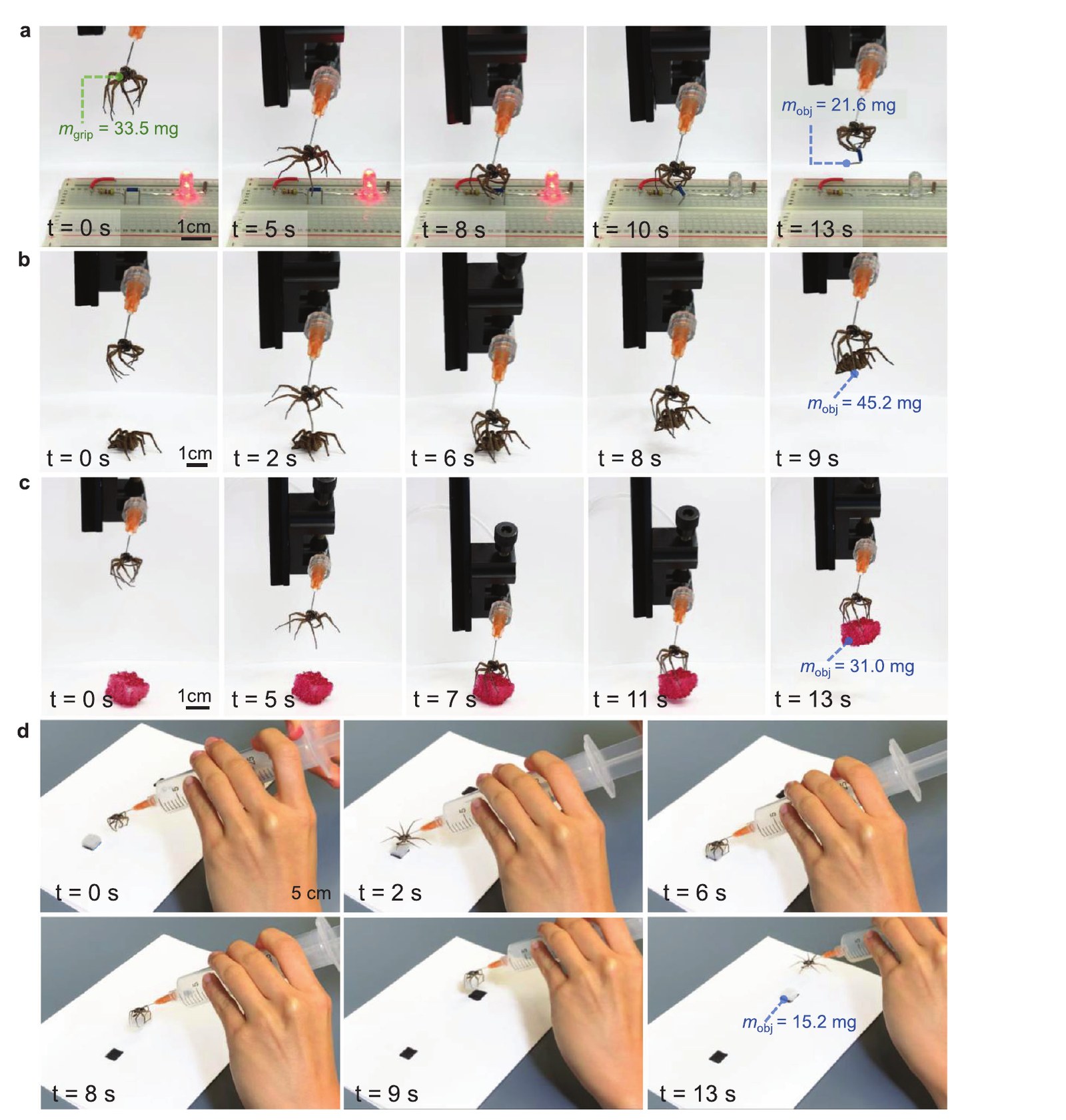
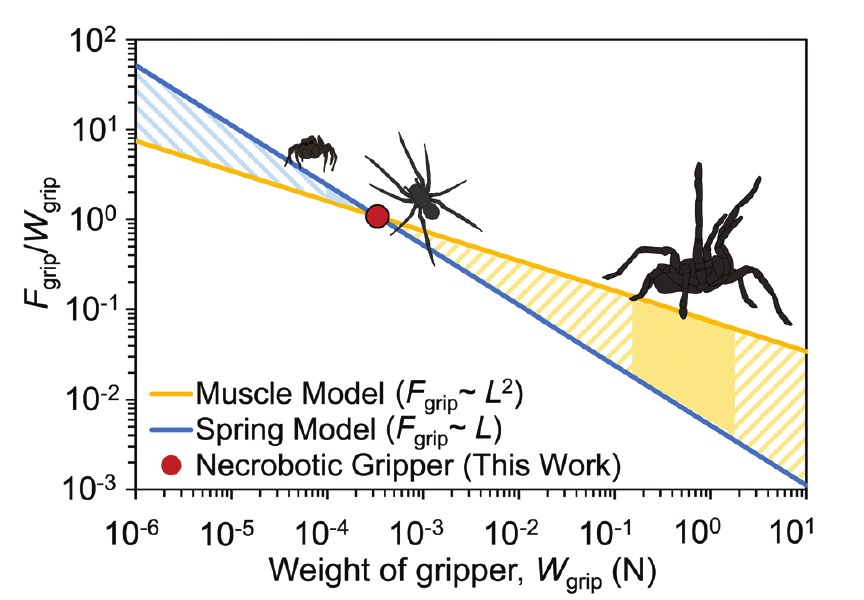
The necrobotic gripper can lift objects 1.3 times its own weight and withstand around 700 actuation cycles before the body begins to degrade. It works on objects of varying geometry, mass, and volume. It can be operated untethered — someone holding the syringe controls the legs by hand. And when it finally fails, it biodegrades. No circuit board to dispose of. No plastics. The packaging is, in every sense, biodegradable.
There is something worth sitting with in the camouflage point the researchers make almost in passing: the necrobotic gripper blends into environments naturally, because it looks like what it is. A spider. No paint, no texture coating, no mimicry required. The body was already the disguise.
Each object’s mass, compared with the gripper’s own
Smaller spiders grip harder for their size
04
It matters? How?
I keep returning to the image of the needle and the superglue. One step. The entire transformation from dead animal to functional tool happens at the moment a needle enters the prosoma and a drop of adhesive seals it. What was already there — the joints, the membrane geometry, the internal chamber, a hundred million years of hydraulic refinement — needed only a single point of entry to become something new. Or rather, to continue being what it already was, just with a different operator.
The paper describes this as “initiating the area of necrobotics.” It is the first formal paper in a field that didn’t exist as a named thing before 2022. Whether the field expands into other species, other biotic structures, other post-mortem utilities — that remains to be written. For now, there is a dead spider in a lab in Houston, opening and closing its legs on command, lifting things with the patient efficiency it would have used in life.
The legs still work. That’s the sentence the entire paper is built around.
The catches
The gripper only worked for about two days before the body dried out and the joints turned brittle; a beeswax coating cut water loss 17-fold, which may stretch that. And the authors point out there are still no clear guidelines on sourcing spiders or euthanising them humanely, something they say needs proper rules.
05
TLDR?
Necromancy, unlocked in four steps...
- 1Spiders open their legs with fluid pressure, not muscles. When they die, the pressure drops and the legs curl shut.
- 2The team pushed a needle into a dead wolf spider and sealed it with a drop of superglue.
- 3Puff air in and the legs open; let it out and they close and grip, with no power needed to hold on.
- 4It lifts up to 1.3× its own weight, lasts about 700 grips, and biodegrades when it’s done.
06
Personal Take
I have always thought of science as something closer to life itself: living, changing, always moving. This paper turned that around for me. It shows that even an arthropod’s body, after death, can be brought straight into a mechanical setting, because the engineering was already done long before anyone picked up a needle.
Reading it, my mind kept drifting to cyberpunk: technology that doesn’t just sit next to the body but is built into it, or out of it. It sounds like science fiction, yet here it is in a peer-reviewed journal. And I can already feel it nudging my own design thinking to be more bio-like, borrowing shapes and mechanisms that look grown rather than machined.
Still, one question keeps bugging me. Do we really need the whole spider? Using the entire body feels a little eerier than it has to be. If what really matters is the legs, the joints and the pressure chamber that drives them, perhaps the next step is a gripper that uses only those parts. For now, I’ll leave that one with a shrug.
← Back to all talks
Discussion
Comments
Register with your email to join the discussion
No comments yet. Be the first to share your thoughts.