Talk 05 — Review
“Mathematician vs Clanker: Navier–Stokes, the Millennium Prize Question Answered?”
Every engineering student meets the Navier–Stokes equations sooner or later, usually as an intimidating block of symbols halfway through a fluids module. They describe anything that flows: water in a pipe, air over a wing, blood in an artery, coffee being stirred. Every CFD package, from a student’s first Ansys Fluent tutorial to the simulations behind Formula 1 cars, is ultimately an attempt to solve them.
And yet, for almost a century, nobody could answer a deceptively simple question about them: if you start with a perfectly smooth flow, does it always stay smooth, or can the equations themselves break down? On 8 September 2026, OpenAI announced that an AI system had produced a proof that they can break down, at least when the right push is applied. Within hours the story was no longer just about maths. Two human mathematicians said the company may have built on their unpublished work. This is my attempt to unpack both halves: the equation, and the fight.
Leray shows weak solutions exist, but whether smooth flows stay smooth stays open.
The Clay Millennium Prize attached to the question since 2000.
Pages in the new proof, plus a computer-checked Lean version.
For about 10,000 AI agents to reach the result, according to OpenAI.
01
Where does the equation come from?
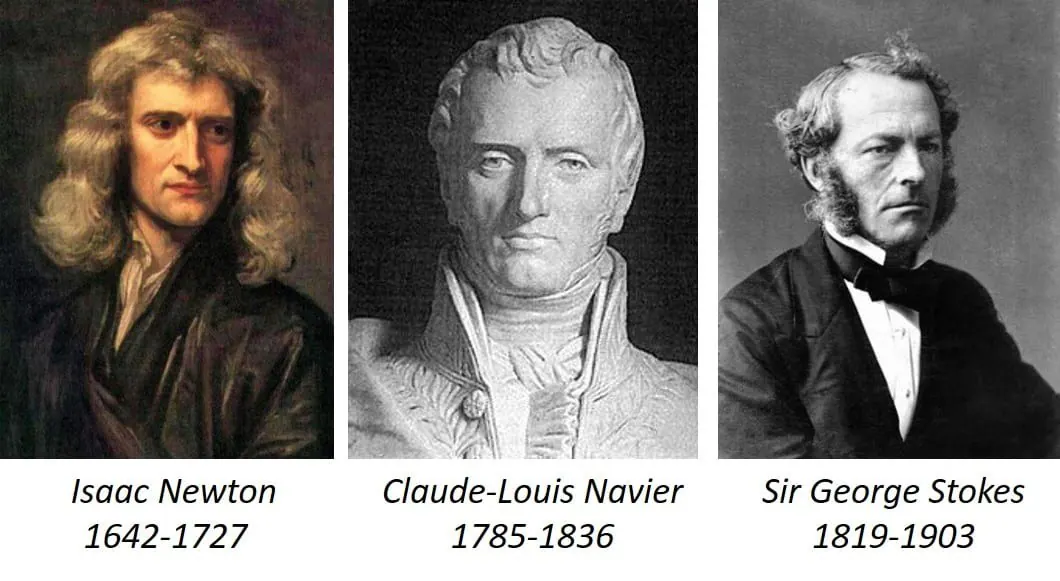
Start with Newton: force equals mass times acceleration. Now imagine chopping a fluid into millions of tiny cubes and writing F = ma for every one of them. That is all Navier–Stokes really is. Claude-Louis Navier wrote the first version in 1822, and George Stokes put it on firmer footing in 1845. Two hundred years later, it is still the equation behind every CFD contour plot I have ever made.
The equation, term by term
The left side is the “ma” part: how a parcel of fluid accelerates. The right side lists the forces acting on it. Each coloured term below has a simple job.
How quickly the flow speeds up or slows down at one spot.
e.g. opening a tap: the water goes from still to rushing.
The flow carries its own speed along with it. It is velocity times velocity, a “squared” term, and it is the troublemaker.
e.g. a river speeding up as it squeezes through a narrow gap.
Fluid gets pushed from high pressure towards low pressure.
e.g. squeezing a tube of toothpaste.
Internal friction. It drags fast bits and slow bits towards the same speed, smoothing sharp swirls out.
e.g. why stirred honey calms down almost instantly.
Any push from outside: gravity, a fan, a spoon.
In this proof: a very carefully designed, perfectly smooth push.
The second line: whatever flows into a tiny box must flow out. Water can’t be compressed.
e.g. squeeze a hose and the water has to speed up.
The tug of war: red versus green
Almost everything interesting about fluids comes down to a fight between two terms. The red transport term feeds on itself and wants to sharpen swirls. The green viscosity term wants to smooth them away. Engineers measure who is winning with one number, the Reynolds number: roughly speed × size ÷ viscosity. Low means syrupy and calm; high means chaotic and turbulent.
Honey dripping off a spoon. Green wins easily.
A goldfish swimming. Starting to swirl.
A person swimming a length. Turbulent wake.
Air over an airliner wing. Red dominates.
This is why turbulence models exist in CFD: at high Reynolds numbers the swirls get too small to simulate directly, so software like Ansys averages them out. The Millennium question asks something deeper. Forget practical limits: can the red term ever win so completely that, in a finite amount of time, the true mathematical solution stops making sense?
The Millennium Prize, in four statements
Prove one of these and the problem is settled
With no external force, any smooth, well-behaved starting flow in all of space stays smooth for all time.
The same, but for a flow in a box that repeats itself in every direction.
There is a smooth start and a smooth force for which the solution blows up in finite time, in all of space.
The same breakdown, in the repeating box.
02
What does “blowup” actually mean?
Here is the whole idea in one line of school maths. Take a quantity y that starts at 1 and grows at a rate equal to its own square: dy/dt = y². The answer is y = 1/(1 − t). At t = 0.5 it is 2. At t = 0.9 it is 10. At t = 0.99 it is 100. At t = 1 it is infinite. It doesn’t just get big, it hits infinity at a definite moment. That is a blowup.
Compare that with something that grows at a rate equal to itself, dy/dt = y. That is ordinary exponential growth: fast, but it stays finite forever. The difference is the square. And the red transport term in Navier–Stokes is exactly that kind of square: velocity times velocity.
One curve grows, the other blows up
Values of y = 1/(1 − t) as t creeps towards 1:
Red: squared growth, which hits infinity at t = 1. Blue: ordinary exponential growth, which never does.
Viscosity acts like a brake on this kind of growth. The question was always whether, in the full 3D equation, the brake can be outrun.
Infinite speed, but not infinite energy
This is the part that confuses people. If the speed becomes infinite, surely the energy does too? Not if the fast region shrinks quickly enough. Kinetic energy is roughly speed² × the amount of fluid that is moving. In the new proof, the spinning core gets faster, but it also gets thinner so quickly that the energy inside it actually goes down.
Roughly like 1/√(time left). Infinite at the blowup.
Its volume shrinks roughly like (time left)1.5.
Roughly like √(time left). So the total stays bounded.
Explaining blowup at a whiteboard, basically
“The speed goes to infinity, but the energy doesn’t, because the tornado gets skinny faster than it gets fast.”
03
What did they show?
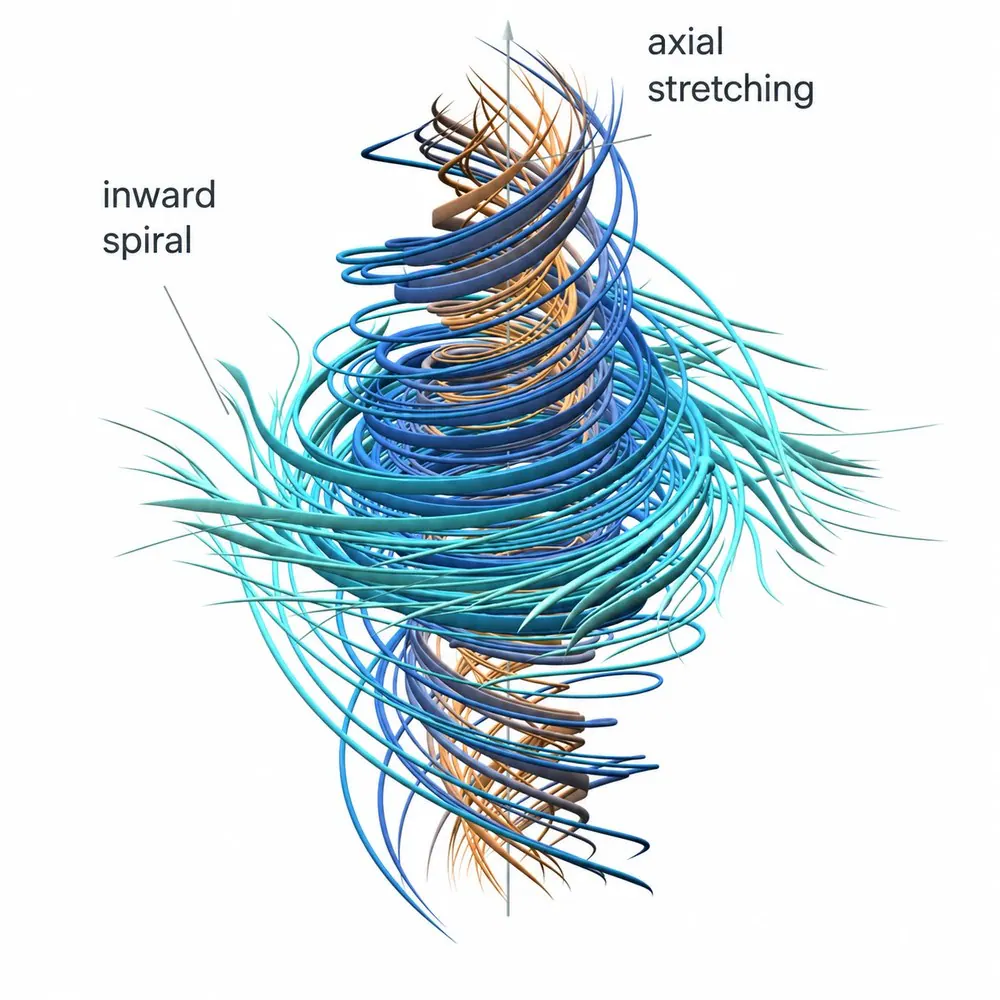
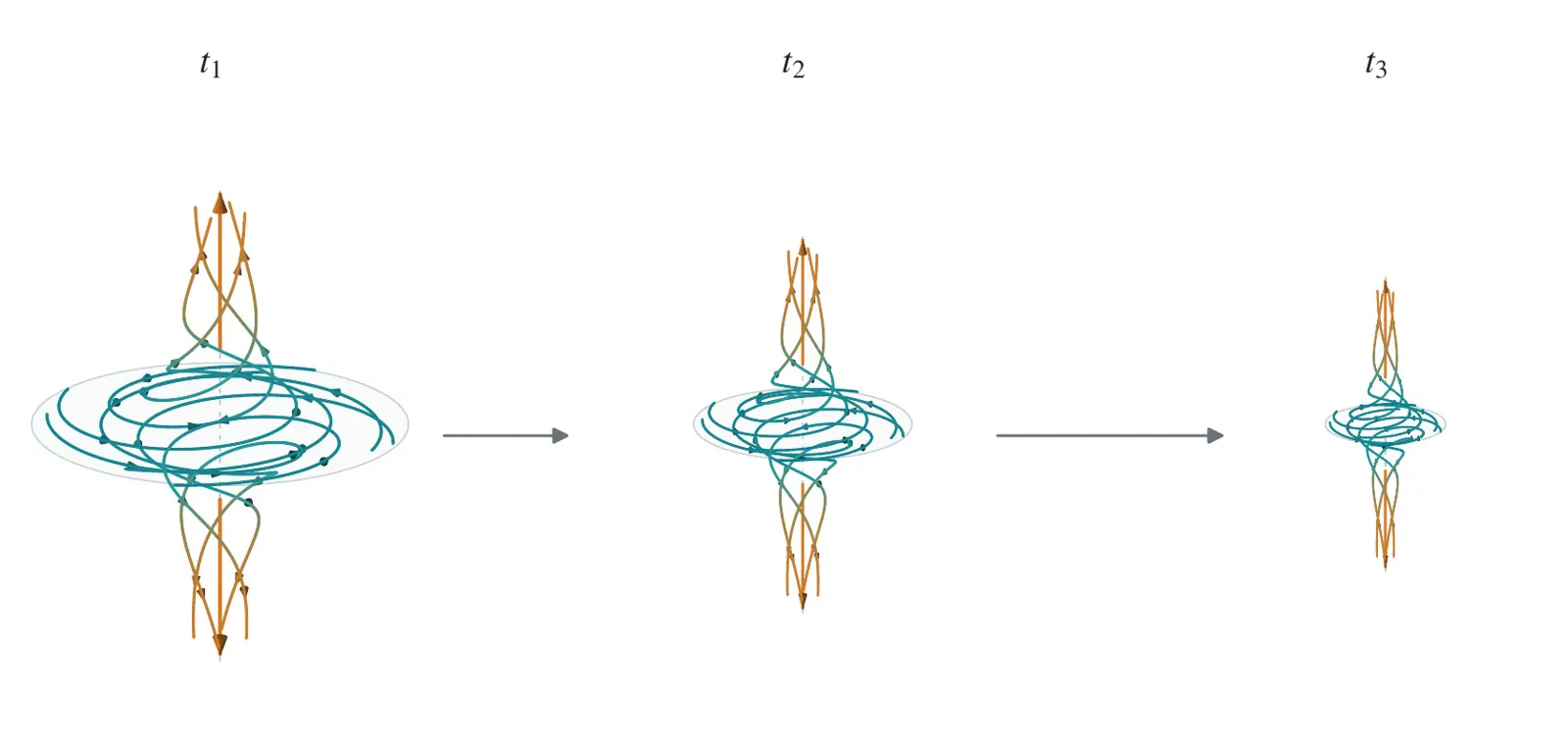
The paper builds a flow that starts completely still. A smooth push is applied, and the fluid organises itself into a slender vortex: fluid spirals in towards the centre and squirts out along the axis, like water around a plughole stretched into a needle.
Think of a figure skater pulling in their arms: they spin faster. The fluid does the same thing. As the spiral pulls inwards, the core spins faster, and as it is stretched along its axis, it gets thinner, which makes it spin faster still. At a precise moment, called t = 1 in the paper, the fastest speeds near the centre become infinite.
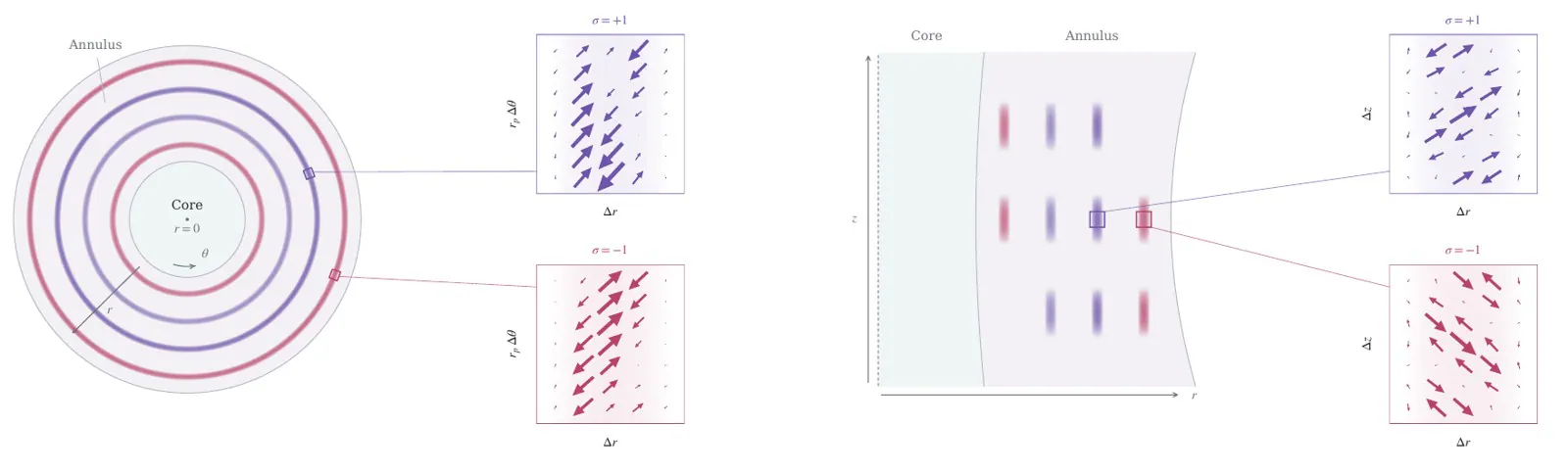
The clever part is the push. Breaking a fluid is easy if your force is allowed to be violent. Here it has to stay perfectly smooth all the way through the blowup. To pull that off, the construction surrounds the vortex with rings of tiny ripples whose combined effect cancels the parts of the force that would otherwise become infinite. The ripples do the dirty work so that the push itself stays clean.
As time runs out, the core shrinks and speeds up
Pick how much time is left before the blowup. The bars show how the vortex core compares with one time unit before, on a scale where each tick is ten times bigger or smaller.
Ten times narrower, ten times faster. The core is becoming a thin, fast-spinning needle.
04
How was it found?
According to OpenAI, the proof was produced by an unnamed internal AI system running as a swarm of cooperating agents, roughly 10,000 of them at once, with access to a cached copy of the internet, code execution and a way to message each other. Different groups were pointed at different versions of the problem, some trying to prove the equations always stay smooth and some trying to break them. The breaking side won, reaching the result on 5 September, about 88 hours after launch.
The proof was then translated into Lean, a programming language for mathematics in which a computer checks every logical step. OpenAI says that took another 17 hours. The company also reported an earlier result from the same system on the Euler equations, which are Navier–Stokes with the viscosity switched off. Keep that detail in mind for the next section.
AI agents working at the same time on the problem.
Messages exchanged between agents on Navier–Stokes alone.
Output tokens of AI-written reasoning for this result.
Extra to produce the machine-checked Lean proof.
05
The awkward part: plagiarism and data-leak allegations
Mathematicians Tristan Buckmaster (NYU) and Levent Alpöge (who works at Anthropic) had been working on closely related blowup results for the Euler equations, the viscosity-free cousin of Navier–Stokes. Their work was unpublished, and they had used AI coding tools, including OpenAI’s Codex, along the way. When OpenAI’s announcement landed, Buckmaster publicly asked whether OpenAI’s system had been trained on, or had access to, their Codex sessions. Here is what happened, as reported. Nothing in this section has been proven either way, and the private conversations have not been independently verified.
Timeline
- 15 AUGBuckmaster and Alpöge obtain blowup results with a smooth force for Euler and two related equations, and check them in Lean about a week later. Not yet published.
- 2–3 SEPAfter hearing their work may have leaked, Alpöge and Buckmaster contact people at OpenAI.
- 5 SEPOpenAI’s system reaches its Navier–Stokes result, according to OpenAI.
- 6 SEPCall between Buckmaster and OpenAI’s Sébastien Bubeck. Accounts differ sharply (see below).
- 7 SEPBuckmaster publishes a statement on his and Alpöge’s Euler results and the call.
- 8 SEPOpenAI announces. It says no specific user data was accessed, but that it “cannot rule out that de-identified data derived from their usage of our products helped improve” its models. Bubeck responds on X; Altman backs him.
- 10 SEPAfter an internal investigation, OpenAI updates its post: Buckmaster’s prompts “could not have influenced the system in any way, including through training.”
What Buckmaster says
- He asked whether OpenAI’s model was trained on, or had access to, his team’s Codex sessions, and says he didn’t get a clear answer about training at the time.
- He says he was offered a path to the prize only if he said OpenAI’s model also solved the problem and dropped Alpöge’s name.
- When he said he would go public, he says Bubeck asked, “Why would you ruin your career?”, which he took as a threat.
What OpenAI says
- Its system never used their prompts or proofs, and its investigation found their Codex prompts could not have influenced it.
- Bubeck says he “never ever” asked to remove Alpöge as an author, but felt it would be inappropriate for an Anthropic employee to author OpenAI’s work.
- Bubeck apologised for the career remark as an “extremely poor choice of words”. Altman says the team acted “with integrity and generosity throughout” and offered to let the pair go first.
What the maths world said
Congratulated both teams on “a milestone advance in human knowledge.”American Mathematical Society
Called the announcements “exciting”, but a Millennium solution must be peer-reviewed and published before any prize.Martin Bridson, Clay Mathematics Institute (via Nature)
Warned that “the indiscriminate strip-mining of open problems” could damage the research ecosystem.Terence Tao, UCLA (via Fortune)
Argued that without the earlier human work on blowups, the AI would not have solved the problem.Diego Córdoba, ICMAT Madrid
06
A good breakthrough? Yes. But at what cost?
I don’t think anyone serious doubts that this is a big moment. A question that sat open for nearly a century now has a candidate answer with a computer-checked proof. But a breakthrough can be real and still come with a bill. Here is what I think it costs.
The AI didn’t start from zero. It learned from a century of human work on exactly these problems. When the headline says “AI solves Navier–Stokes”, the people whose ideas made it possible can disappear from the story.
Even if nothing leaked here, OpenAI’s first statement admitted it couldn’t rule out de-identified usage data helping its models. If researchers start to worry about that, they may stop using these tools, or stop sharing ideas early.
Ten thousand agents and around 130 billion tokens is not something a university department can run. The compute reportedly cost millions of dollars, plus the energy that goes with it. Big questions may become something only a few companies can attempt.
Lean can confirm every step is valid. It can’t tell us why the construction works, or what the failed attempts taught. That insight is what mathematicians build on next.
The result went out through a company blog and social media before any journal or the Clay Institute had looked at it. If the race to announce becomes the norm, the slow, careful checking that science relies on gets squeezed.
07
So, is it solved?
Not quite, or at least not yet officially. A few things are worth keeping in mind as I write this:
- 1It is the “forced” version. The blowup needs a carefully designed, smooth push from outside. The unforced question (statements A and B), whether real water left to itself can ever break down, is still open.
- 2It has not been through the Clay process. The prize rules ask for publication in a respected journal and two years of scrutiny by mathematicians. No award has been made, and OpenAI has said it does not intend to claim the prize.
- 3A computer check is not the whole story. Lean confirms the logic is airtight, but humans still have to confirm that the formal statement really matches the problem as posed, and to understand why the construction works.
- 4The credit question is still open. OpenAI says its investigation clears it; Buckmaster and Alpöge’s account of how things unfolded differs. How the history gets written may take longer than the maths.
08
It matters? How?
For day-to-day engineering, nothing changes tomorrow. Pumps, pipes and wings don’t come with a perfectly tuned force designed to make them singular, and CFD codes already smooth things over with meshes and turbulence models. If anything, the result is reassuring in a strange way: it shows that breaking the equations takes an extraordinarily delicate setup.
What does change is our understanding of the mathematics we lean on, and how that mathematics gets made. Knowing the equations can produce infinite speeds from smooth beginnings tells us they are not quite as “safe” as we assumed, and it puts the spotlight back on the unforced case. And the method, thousands of AI agents in under four days, followed by a public fight over credit, is going to shape how the next big problem gets attacked and announced.
09
TLDR?
From plughole to press release, in five steps...
- 1Navier–Stokes is F = ma for fluids. A squared “transport” term fights against viscosity, and nobody knew if it could ever win completely.
- 2A squared growth rate can hit infinity at a fixed time (y = 1/(1 − t)). That is what “blowup” means.
- 3An AI system at OpenAI built a smoothly pushed vortex whose speed becomes infinite in finite time while its energy stays bounded: Millennium statements C and D.
- 4Buckmaster and Alpöge questioned whether their unpublished Euler work fed into it. OpenAI denies it. Accounts of the private talks differ.
- 5It’s the forced version, it still needs peer review, and the bigger questions are about credit, trust and cost.
10
Personal Take
This equation sits very close to my head, and honestly to my heart too. During my fluids course it was one of my kryptonites: a wall of symbols that seemed designed to make me feel slow. But the more I learned about it, the more it turned from an enemy into a tool. These days it’s behind almost every simulation I run in Ansys, every CFD case where I’m watching residuals drop and velocity contours appear.
So this news gave me very mixed feelings. Part of me felt oddly vindicated: it took around ten thousand AI agents, billions of tokens and a mountain of computing power to crack even the forced version. This equation really is that hard to crack, and that hard to use.
But I don’t want this to become the story of a giant corporate win.
The AI didn’t start from a blank page. It stood on Leray’s 1934 work, on decades of blowup research by mathematicians like Diego Córdoba, Tristan Buckmaster and Levent Alpöge, and on every paper, lecture note and late-night proof it learned from. Whatever happened in those private calls, I’m fairly sure the company couldn’t have got there by itself without that body of human work. Mathematicians around the world have spent their careers on this question, and their contribution shouldn’t shrink just because a machine wrote the final 166 pages.
So, Mathematician vs Clanker? I don’t think it was ever really “versus”. The best version of this future is one where both get the credit they’re due, and where the people who did the groundwork aren’t left out of the photo. For now, the water in my pipes is still behaving. The mathematics underneath, and the ethics around it, just got a lot more interesting.
Discussion
Comments
Register with your email to join the discussion
No comments yet. Be the first to share your thoughts.