Talk 04 — Review
“Amaze, Amaze, Amaze: The Science (and the Heart) of Project Hail Mary”
Every other Talk on this page starts from a research paper. This one starts from a novel, and now a film, but I’d argue it belongs here just the same. Andy Weir, who also wrote The Martian, has a habit of writing science fiction where the science is doing real work: if the hero survives, it’s because the maths checked out.
Project Hail Mary is the story of one very confused man on a spaceship, one very unexpected friend, and a lot of problem-solving between them. The film adaptation landed in cinemas on 20 March 2026, so this felt like the right moment to pull apart a few of the ideas that make the story tick, and why it stuck with me long after the credits.
The novel is published. The film follows five years later.
Distance to Tau Ceti, the star the Hail Mary is sent to.
Cable between the two halves of the ship when it spins for gravity.
Gravity on Rocky’s home planet, Erid. Our 1 g is a light day for him.
I talk about the setup and one reveal from the middle of the book. The ending stays untold.
01
What’s the story?
The Sun is getting dimmer. A microscopic organism, nicknamed Astrophage, is feeding on its energy, and scientists can see a faint line of it stretching from the Sun to Venus. If nothing changes, Earth faces an ice age within decades. One nearby star, Tau Ceti, seems to be infected but isn’t dimming. Humanity builds a ship, the Hail Mary, to find out why.
Ryland Grace wakes up on that ship with no memory of who he is. Bit by bit he works it out: he’s a junior-high science teacher, he’s light years from home, and his two crewmates didn’t survive the trip. Then another ship appears next to his. Inside is an engineer from a planet called Erid, whose star has the same problem. Grace names him Rocky.


Me, when I learned the alien is basically a rock called Rocky
He has five legs, no eyes, a shell tougher than most of our metals, and he lives in a scalding ammonia atmosphere at about 29 times Earth’s air pressure. He is also, somehow, the most lovable character in the whole story.
02
Spin to win:
making gravity with a centrifuge
Science fiction usually hand-waves gravity on spaceships. Weir doesn’t. The Hail Mary has no magic gravity plates. When it needs gravity, it splits in half. The front (crew compartment and lab) and the back (engines and tanks) unspool about 100 metres of cable between them and start spinning around each other, like two dancers holding hands and leaning back.
Why does spinning feel like gravity? Anything moving in a circle needs a constant push towards the centre, or it would fly off in a straight line. On the Hail Mary, the floor provides that push. Your body feels the floor pressing on your feet, and that pressure is exactly what weight feels like. The faster the spin, or the further you are from the centre, the heavier you feel. To make “down” point at the floor, the crew compartment even swivels 180°, so the nose faces inwards.
How a spaceship turns itself into a centrifuge
Step through the sequence Grace runs from the “Engage Centrifuge Sequence” button, or press play. The readout uses the numbers from his screen in the book.
One long ship. While the engines fire, the crew are pressed towards the back of the ship, so “down” points at the engines.
The book even gives us the numbers, so I checked them. The back half is about three times heavier than the front, so the pair spins around a point a quarter of the way along the 104-metre cable. That puts the crew compartment about 78 metres from the centre. At the spin rate on Grace’s screen, one full turn every 17 seconds or so, that works out to just over 1 g. Weir’s maths holds up.
Spin faster, feel heavier
Pick a spin rate. The readout shows the gravity felt in the crew compartment, 78 metres from the centre, and how heavy a 70 kg person would feel.
The Hail Mary’s setting in the novel: one turn every 17 seconds gives about 1 g in the crew compartment.
03
Talking in chords:
learning Rocky’s language
Rocky has no eyes. Eridians “see” with sound, and they speak in music: every word is a chord, several notes played at once. Grace has a decent ear, but no human can reliably pick apart four notes sung at the same instant, never mind remember thousands of them. So he does what any scientist would do. He measures.
His tool is the Fourier transform, run through waveform-analysis software on a laptop. It works like a prism for sound. A prism takes white light and splits it into its colours; a Fourier transform takes one messy, wobbly sound wave and splits it into the pure notes inside it. Play a C-major chord and it tells you: C, E and G. Try it below.
One messy wave in, a list of notes out
Switch notes on and off. The top panel is what a microphone records: all the notes added together. The bottom panel is what the Fourier transform finds.
Found: C · E · G. That is C major, the exact example Grace uses in the book.
Played together, the notes blur into one sound, which is what Grace hears. Played one by one, you can pick each of them out, which is what the Fourier transform does for him. The last button is my own made-up imitation of chord-speech, not Rocky’s voice from the film.
From chords to a dictionary
Rocky “says” a word. The laptop records the sound wave.
The Fourier transform lists the notes in the chord, like C, E and G above.
A spreadsheet matches that set of notes to an English word. Numbers and objects first, then everything else.
It is tempting to call this machine learning, and it sits very close to it: today’s speech-recognition and AI language tools start in exactly the same place, turning sound into its frequencies before anything else happens. But in the book, the “learning” is all Grace. He builds the dictionary himself, one word at a time, pointing at objects and counting on his fingers, then practises with a keyboard until he barely needs the laptop. Rocky learns English the same way, without any software at all, which says a lot about Eridian memory. By the end of their first weeks together they share a cheerful pidgin of their own, where questions end with the word “question” and anything wonderful gets an “amaze”.




04
Made, not just rendered: the film’s practical magic
The film could easily have made Rocky a digital creature and filmed everything else against green screen. It didn’t. Co-director Christopher Miller has said they used no green or blue screens at all. The ship’s interior was built as a full set, along with a large section of the exterior, and Rocky was a real, hand-built puppet on set with Ryan Gosling.
Rocky was designed by Neal Scanlan’s team and performed by puppeteer James Ortiz, using a mix of motor-driven animatronics and rod puppetry. Cinematographer Greig Fraser described him as a blend of five or six different techniques, and deliberately lit him so that, without a face, he never reads as threatening. The light on set did a lot of the storytelling too: for the scenes near the planet Adrian, the crew bounced a green-blue light onto Gosling instead of adding it afterwards, so the colour on his suit is real.
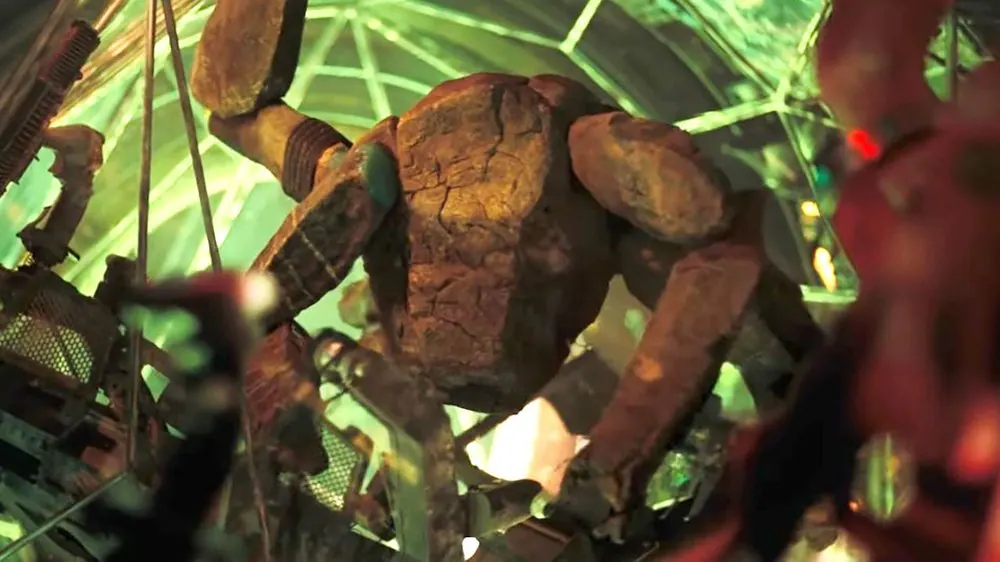

That doesn’t mean there’s no computer work. Miller was quick to point out there are still thousands of visual-effects shots: wires and puppeteers painted out, space exteriors built digitally, and Rocky’s puppet performance blended with animation by Framestore. But starting from something real, in the room with the actor, is why Rocky feels like a character rather than an effect. Even the VFX team admitted they sometimes couldn’t remember which shots were puppet and which were CG.

05
First contact, without the horror
Most first-contact stories are horror stories. From Alien to A Quiet Place, the unknown thing in the dark is something that wants to eat you, and that makes sense: fear of the unknown is a survival instinct that kept our ancestors alive. Project Hail Mary sets up every beat for that kind of story. A man alone, a strange ship appearing next to his, an alien object arriving through the airlock.
And then the alien turns out to be a nerdy engineer who is just as lonely, just as scared and just as desperate to save his home. The tension never comes from Rocky. It comes from physics, from biology, from running out of time. The two of them start out separated by a transparent wall that can hold back their very different atmospheres, and the whole story is about how much that wall stops mattering.

How we’re trained to meet an alien
Decades of science fiction have taught us that the thing on the other side of the airlock wants to eat us. Project Hail Mary had every chance to go that way, and didn’t.
06
Two kinds of desperation
The mid-book reveal (spoiler ahead): Grace didn’t volunteer. When the mission leader, Eva Stratt, asked him to go, he said no. She had him held, sedated and put on the ship anyway, because he was the best qualified and the whole world was at stake. Rocky is facing exactly the same end of the world, for his own people. The story quietly puts the two side by side.

Earth’s mission leader · played by Sandra Hüller
Eva Stratt
- What drives her
- Saving the human race, at any cost. She is usually right, which is what makes her frightening.
- What she does with Grace’s choice
- Takes it away. A no is just a problem to be solved.
- What it costs
- Grace’s trust, and any say he had over his own life.
Erid’s engineer · puppeteered by James Ortiz
Rocky
- What drives him
- Saving his planet, every bit as desperate as Stratt.
- What he does with Grace’s choice
- Respects it. He shares what he knows, asks before he acts and treats Grace as a partner.
- What it costs
- Sometimes his own safety. When the ship goes wrong, he risks his life, and his whole mission, to save a human he has known for weeks.
Stratt isn’t a villain, and the book is fair to her: her logic is hard to argue with. But Rocky shows another way to carry the weight of the world. Same stakes, same pressure, and he still chooses kindness. Grace notices. It is, in the end, what changes him.
07
TLDR?
From dimming Sun to “fist my bump”, in four steps...
- 1A sun-eating microbe threatens Earth; a science teacher wakes up alone on a ship light years away and meets Rocky, an alien engineer with the same problem.
- 2The ship makes its own gravity by splitting in two and spinning on 104 m of cable. The book’s numbers really do give about 1 g.
- 3Rocky speaks in chords. Grace decodes them with a Fourier transform and a spreadsheet, the same first step modern speech software takes.
- 4The film builds Rocky as a real puppet, and the story swaps alien horror for friendship, setting Stratt’s ruthless desperation beside Rocky’s kind one.
08
Personal Take
What I love most about Project Hail Mary is that it makes you want to check its work. I finished the centrifuge chapter and immediately got out a calculator, and I suspect a lot of readers did the same. A rotating ship, a Fourier transform, relativity, a microbe that stores energy: the book drops real concepts in front of you and trusts you to find them as exciting as Grace does. For anyone who thinks science is a list of facts to memorise, this is a much better advert for it than any textbook: science as curiosity, as play, as the thing that gets you out of trouble.
The film earns that same trust in its own way. Knowing that Rocky was a real puppet, moved by real people in a real set, changes how you watch him. He has weight. He takes up space next to Ryan Gosling. It is the opposite of the weightless, everything-is-CGI feeling of a lot of blockbusters, and it makes the friendship land.
It also shatters the idea that an alien has to be a monster.


We are wired to fear the unknown, and science fiction has leaned on that for decades. Here, the unknown turns out to be a friend who says “amaze” when he learns something new. Rocky is a far more compelling character than I expected, and a lot of that comes from the contrast with the humans around Grace. Eva Stratt and Rocky are both desperate, both carrying the fate of a whole planet. Stratt answers that pressure by taking away Grace’s choices. Rocky answers it by giving Grace every choice he can, even when it costs him.
That is the part I keep coming back to. Desperation and struggle don’t have to make you cruel or heartless. Sometimes the best motivation, even at the end of the world, is compassion and kindness. Amaze, amaze, amaze.
← Back to all talksDiscussion
Comments
Register with your email to join the discussion
No comments yet. Be the first to share your thoughts.