Everyone has been told to “sleep on it”. Dmitri Mendeleev is said to have seen the periodic table in a dream. Paul McCartney woke up with the melody of Yesterday in his head. Mary Shelley’s Frankenstein began as a vivid night-time vision. Great stories, but they are only stories. Nobody can prove the dream did the work, rather than the hours of thinking before it or the shower after it.
A team at Northwestern University decided to stop collecting anecdotes and start steering dreams. They gave people puzzles they couldn’t solve, quietly played each puzzle’s sound while they were in REM sleep, and asked them, quite literally, to keep working on it in the dream. Then they checked who solved what the next morning.
Sleepers, most of them frequent lucid dreamers.
Dream reports, collected over 35 nights in the lab.
Of unsolved puzzles turned up in a dream, on average.
Solved next morning: puzzles dreamed about vs not.

Pre-sleep viewing
While the sensors went on, 16 of the 20 participants watched Inception. No pressure, then.
01
There is decent lab evidence that sleep helps with creative problems: in several studies, people are more likely to crack a puzzle after a night’s sleep than after the same time awake. The evidence that dreaming is what helps is much weaker. Correlations can’t tell you whether the dream caused the insight. And experiments that simply ask people to think about a problem before bed can’t separate the dream from the thinking.
The tool the team used is called targeted memory reactivation, or TMR. A sound that was linked to something during the day is replayed quietly during sleep, nudging the brain to revisit that memory. The twist is who they tested. Most of the 20 participants have lucid dreams at least once a month (they know they are dreaming while it happens), so they could be asked to work on a puzzle inside the dream, and even tell the experimenters, in real time, that they were doing it.
Each participant did this twice, about a week apart, with different puzzles. Pick a step.
Step 1 · 10 pm
Solve puzzles one at a time, 3 minutes each, while that puzzle’s own soundtrack loops. Keep going until four are left unsolved, then learn which sound goes with which puzzle.

02
In REM sleep your body is paralysed, apart from two things: your eyes and your breathing. So that is the keyboard. Before sleep, participants agreed on two signals. Looking hard left-right-left-right means “I’m lucid”. A burst of quick sniffs means “I heard a puzzle sound and I’m working on it”. Both stand out clearly on the sensors, so the team could watch a message arrive from inside a dream while the person was still asleep.
The recording replays as it happened, 2.5× faster than real time; pick a moment to pause on it. The traces are redrawn to show the pattern; the real recording is in “Show the science”.
Recording live from a sleeper in REM: brainwaves, both eyes, chin muscle and breathing through the nose. Watch for messages.
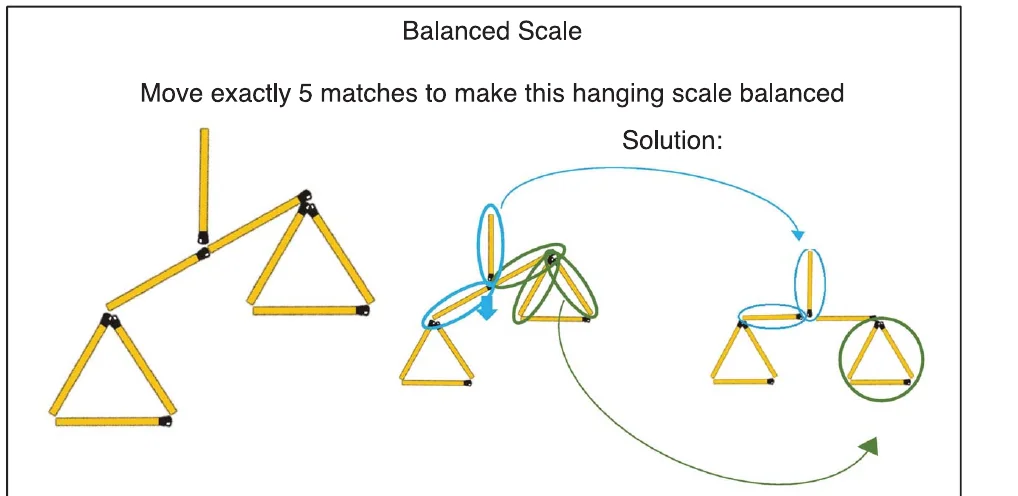
A hanging scale made of 9 matches: a post, a tilted beam and a triangle on each end. Move exactly 5 of them so it hangs level.
When she woke, she described searching her dream for the puzzle and asking dream characters for help, then getting on a seesaw: “That’s how I realized the scales weren’t flat.” She never solved this one. Can you?
03
Yes, more often than you might expect. Participants reported about two dreams a night, 71 in total, and 15 of the 20 had at least one dream about an unsolved puzzle. On average, a quarter of each person’s unsolved puzzles turned up in a dream. Sometimes directly, sometimes as something puzzle-shaped: one person was catching fish in a river with a net and felt like they were “working on something… like a puzzle”. They solved it the next morning.
Crucially, the puzzles whose sounds were played turned up far more than the ones left alone. Being lucid helped too: about a quarter of the puzzles cued during lucid dreams made it into the dream, against fewer than one in ten during ordinary dreams.
All dreams
Cued puzzles, by type of dream

Meanwhile, in the sleep lab
“I bet he’s thinking about someone else.” He is thinking about how to move exactly five matches.
04
This is the question the whole study is built around, and the honest answer is “partly”. Pick a comparison:
Puzzles that showed up in a dream were solved the next morning about two and a half times as often (p = .037). Just hearing the sound in a dream, without the puzzle itself appearing, didn’t help.
Put together: when a sound managed to steer a dream towards a puzzle, that puzzle was more likely to be solved. When people heard the sound but the puzzle itself never appeared in the dream, there was no benefit. That is a hint that the dream is doing something, not just the sound.
Trying hard, even inside a dream, may not be the best way to have an idea.
The lucid result is the twist. The authors suggest that deliberate effort may drag you back onto the same wrong approach you were stuck on while awake, while ordinary dreams let you forget it and wander towards distant associations.
05
Dream research has a chicken-and-egg problem. People who dream about a task often do better at it the next day, but maybe they dream about it because they were already more engaged. This study flips the direction. By choosing at random which puzzles to play into REM sleep, the team could push dreams towards particular problems and then follow exactly those problems into the morning.
It is also a lovely piece of method. Two-way communication with a sleeping person, sounds going in and eye movements and sniffs coming out, turns the dream from something you describe over breakfast into something you can run an experiment inside.
The catches
Only 20 people and about eight unsolved puzzles each, so the study had little statistical power. Across everyone, the sounds had no reliable effect on solving. The clear benefit only appears after splitting people into targeted dreamers and non-responders, and that split was made after the data came in. The design can’t rule out that people simply thought about a dreamed-of puzzle after waking. Participants knew sounds might be played, and frequent lucid dreamers aren’t typical sleepers. And every puzzle had one right answer, so it says nothing yet about open-ended creativity.
06
Dream engineering, in four steps...
07
“Sleep on it” is advice I have heard my whole life, usually as a polite way of saying “stop thinking about it for now”. What I like about this paper is that it stops treating that advice as folklore and builds an instrument to test it. As an engineer, the part that impressed me most isn’t even the result; it’s the interface. A person in REM sleep can’t speak or move, so the team built a communication protocol out of the only two channels left: the eyes and the breath. That is real-time telemetry from inside a dream.
The finding that surprised me is the lucid one. You would expect being aware inside your dream to be the superpower, the moment you can sit down and deliberately work on the problem. Instead, puzzles that appeared in ordinary dreams were solved more often, and the best rate came from dreams people had already forgotten. I find that oddly comforting. Sometimes the most useful thing your brain can do with a problem is to stop holding it so tightly.
I wouldn’t plan an exam around it yet: twenty people, a handful of puzzles each, and the clearest effect only shows up after splitting the group. But as a first step it is exactly the kind of experiment I enjoy. Take an old anecdote, design a clever rig, and make the question measurable. Next time I am stuck on a design problem, I might just go to bed.
← Back to all talks

Discussion
Register with your email to join the discussion
No comments yet. Be the first to share your thoughts.
Everyone has been told to “sleep on it”. Dmitri Mendeleev is said to have seen the periodic table in a dream. Paul McCartney woke up with the melody of Yesterday in his head. Mary Shelley’s Frankenstein began as a vivid night-time vision. Great stories, but they are only stories. Nobody can prove the dream did the work, rather than the hours of thinking before it or the shower after it.
A team at Northwestern University decided to stop collecting anecdotes and start steering dreams. They gave people puzzles they couldn’t solve, quietly played each puzzle’s sound while they were in REM sleep, and asked them, quite literally, to keep working on it in the dream. Then they checked who solved what the next morning.
Sleepers, most of them frequent lucid dreamers.
Dream reports, collected over 35 nights in the lab.
Of unsolved puzzles turned up in a dream, on average.
Solved next morning: puzzles dreamed about vs not.
Pre-sleep viewing
While the sensors went on, 16 of the 20 participants watched Inception. No pressure, then.
01
There is decent lab evidence that sleep helps with creative problems: in several studies, people are more likely to crack a puzzle after a night’s sleep than after the same time awake. The evidence that dreaming is what helps is much weaker. Correlations can’t tell you whether the dream caused the insight. And experiments that simply ask people to think about a problem before bed can’t separate the dream from the thinking.
The tool the team used is called targeted memory reactivation, or TMR. A sound that was linked to something during the day is replayed quietly during sleep, nudging the brain to revisit that memory. The twist is who they tested. Most of the 20 participants have lucid dreams at least once a month (they know they are dreaming while it happens), so they could be asked to work on a puzzle inside the dream, and even tell the experimenters, in real time, that they were doing it.
Each participant did this twice, about a week apart, with different puzzles. Pick a step.
{{nt.k}}
{{nt.text}}
The puzzles came from a bank of 25 matchstick, rebus and spatial puzzles, chosen because they need a sudden change of approach rather than step-by-step working. Each was paired at random with one of 27 short music or nature clips: 8–12 seconds of sound, then 3–7 seconds of silence so the brain doesn’t tune it out. Before bed, participants had to name the right puzzle for each sound, four times over.
In REM sleep, cues started at the quietest volume the person could detect and paused at any sign of waking: muscle tension, alpha waves, or the eyes going still. Both puzzles got cued in 62% of REM periods; in the rest, only one did.

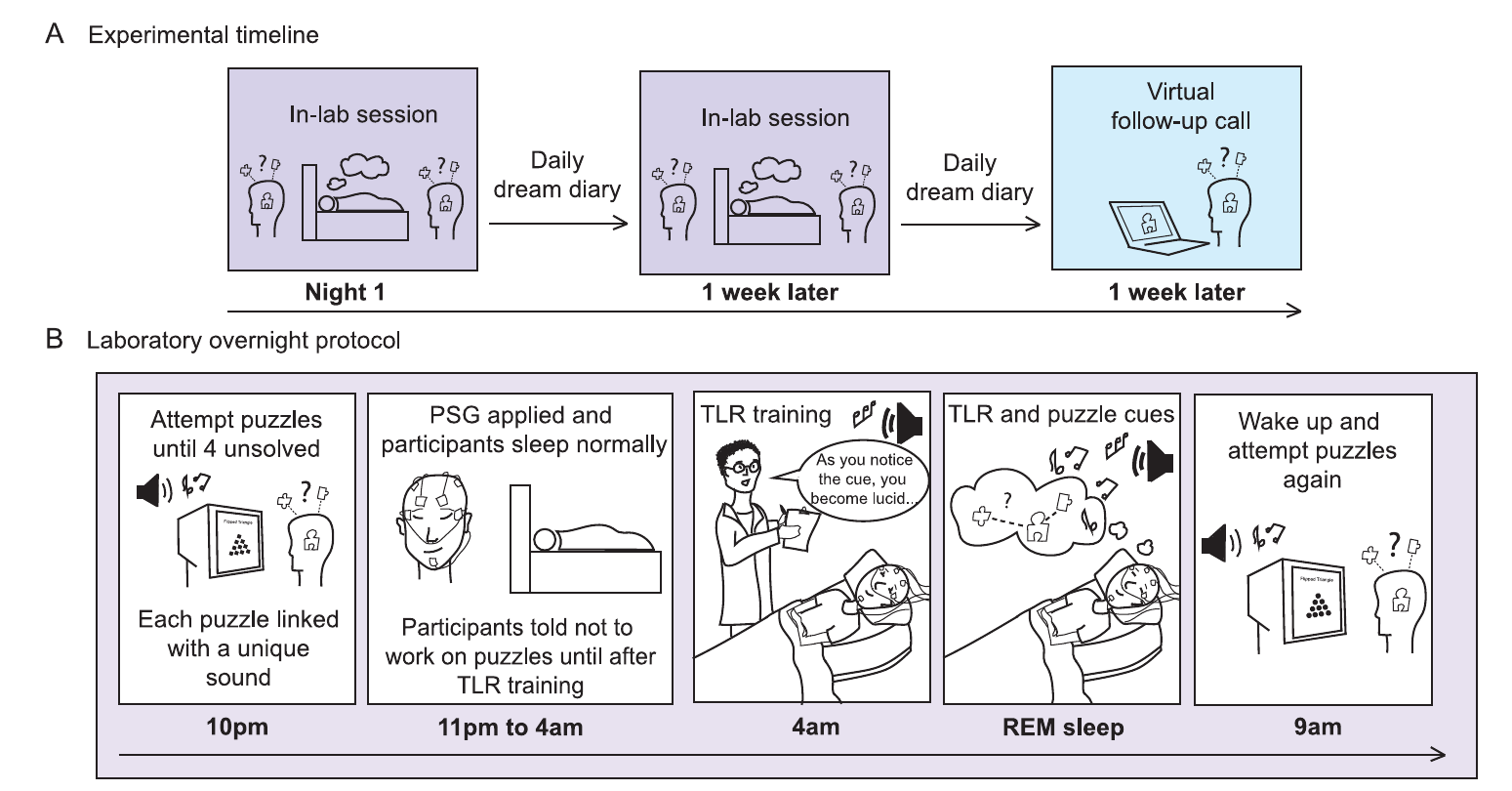
Paper Fig. 1. (A) Two lab nights about a week apart, with a dream diary in between and a video call a week later. (B) One lab night: puzzles with their sounds at 10 pm, normal sleep until 4 am, lucidity training, puzzle cues during REM sleep, and a retest at 9 am.


02
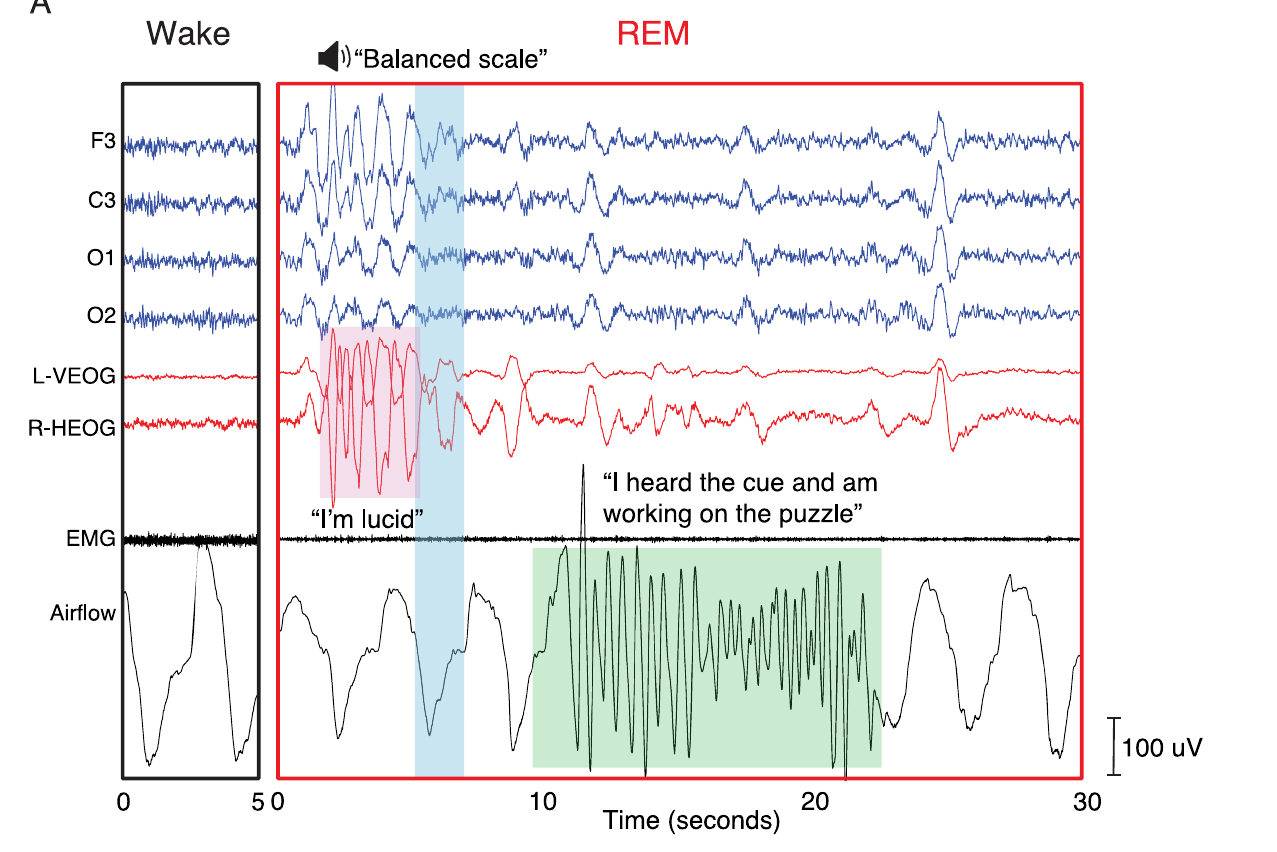
In REM sleep your body is paralysed, apart from two things: your eyes and your breathing. So that is the keyboard. Before sleep, participants agreed on two signals. Looking hard left-right-left-right means “I’m lucid”. A burst of quick sniffs means “I heard a puzzle sound and I’m working on it”. Both stand out clearly on the sensors, so the team could watch a message arrive from inside a dream while the person was still asleep.
The recording replays as it happened, 2.5× faster than real time; pick a moment to pause on it. The traces are redrawn to show the pattern; the real recording is in “Show the science”.
Recording live from a sleeper in REM: brainwaves, both eyes, chin muscle and breathing through the nose. Watch for messages.
Lucidity signals are two large, evenly paced sweeps of the eyes, easy to tell apart from ordinary REM eye movements. Sniffs were counted as a reply if they came within 15 seconds of a puzzle cue. Thirteen lucid dreams were confirmed this way, from six participants.

Paper Fig. 2A. The real recording. After signalling lucidity with left-right eye movements (pink), the participant heard the cue “Balanced scale” (blue) and answered with rapid sniffs (green).
A hanging scale made of 9 matches: a post, a tilted beam and a triangle on each end. Move exactly 5 of them so it hangs level.
When she woke, she described searching her dream for the puzzle and asking dream characters for help, then getting on a seesaw: “That’s how I realized the scales weren’t flat.” She never solved this one. Can you?

Paper Fig. 2B. The original drawing. The puzzle above is redrawn from it; the paper notes it’s unclear whether her dream gave her anything useful.
03
Yes, more often than you might expect. Participants reported about two dreams a night, 71 in total, and 15 of the 20 had at least one dream about an unsolved puzzle. On average, a quarter of each person’s unsolved puzzles turned up in a dream. Sometimes directly, sometimes as something puzzle-shaped: one person was catching fish in a river with a net and felt like they were “working on something… like a puzzle”. They solved it the next morning.
Crucially, the puzzles whose sounds were played turned up far more than the ones left alone. Being lucid helped too: about a quarter of the puzzles cued during lucid dreams made it into the dream, against fewer than one in ten during ordinary dreams.
All dreams
Cued puzzles, by type of dream
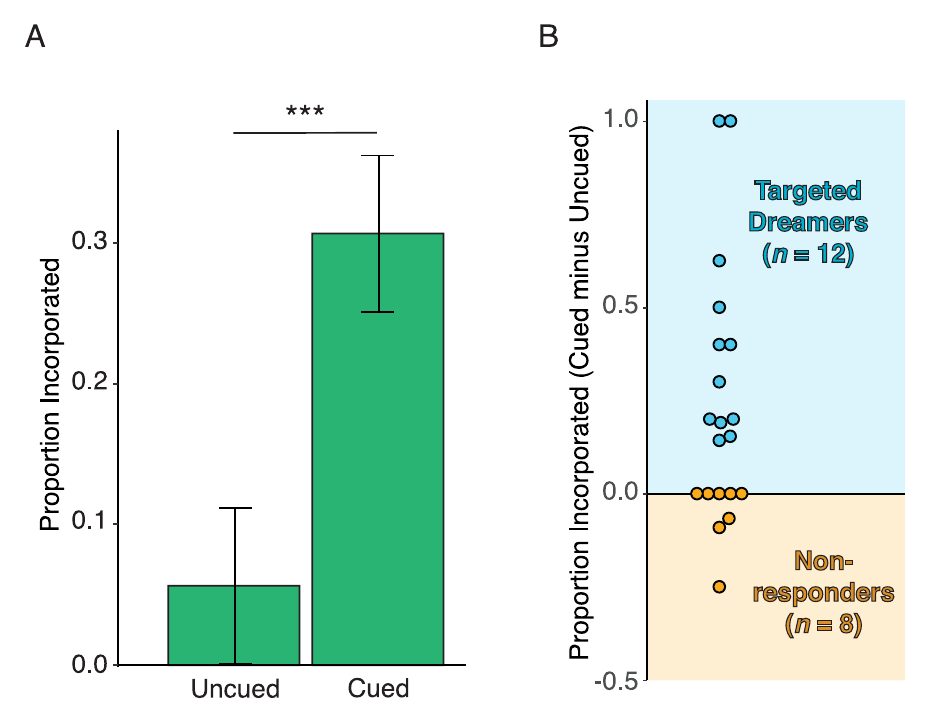
Not everyone responded the same way. Twelve participants, the authors’ “targeted dreamers”, dreamed more about cued puzzles than uncued ones: on average 43% more. The other eight “non-responders” dreamed slightly less about cued puzzles (5% less on average). Two blind raters scored every dream report, without knowing which puzzles had been cued.

Paper Fig. 3. (A) Cued puzzles were incorporated into dreams far more often than uncued ones. (B) Each dot is one person: cued minus uncued incorporation. Above zero are the 12 targeted dreamers; at or below zero, the 8 non-responders.
Meanwhile, in the sleep lab
“I bet he’s thinking about someone else.” He is thinking about how to move exactly five matches.
04
This is the question the whole study is built around, and the honest answer is “partly”. Pick a comparison:
{{d.note}}
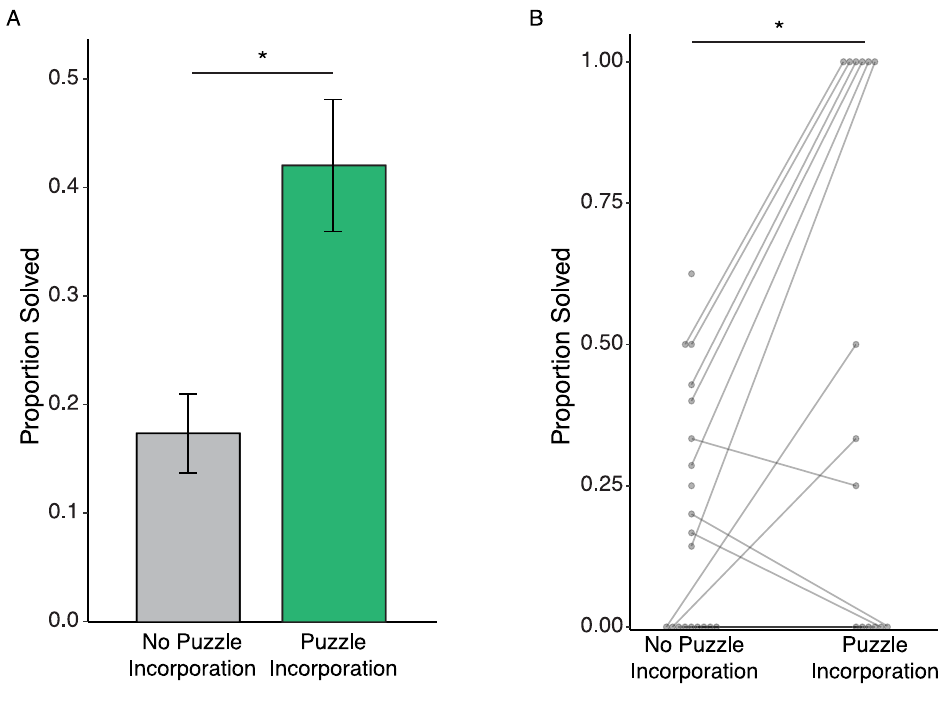
Solving was analysed with mixed-effects models that account for each person’s overall ability. A puzzle appearing in a dream predicted solving it (p = .037); merely hearing the sound inside a dream did not. Across everyone, the interaction between cueing and dreaming only trended (p = .057), so the authors could not run their planned test of whether dreaming explained the effect of the sounds. The targeted-dreamer split was a follow-up analysis.

Paper Fig. 4. Puzzles that appeared in dreams were solved more often (A), shown per participant in (B).

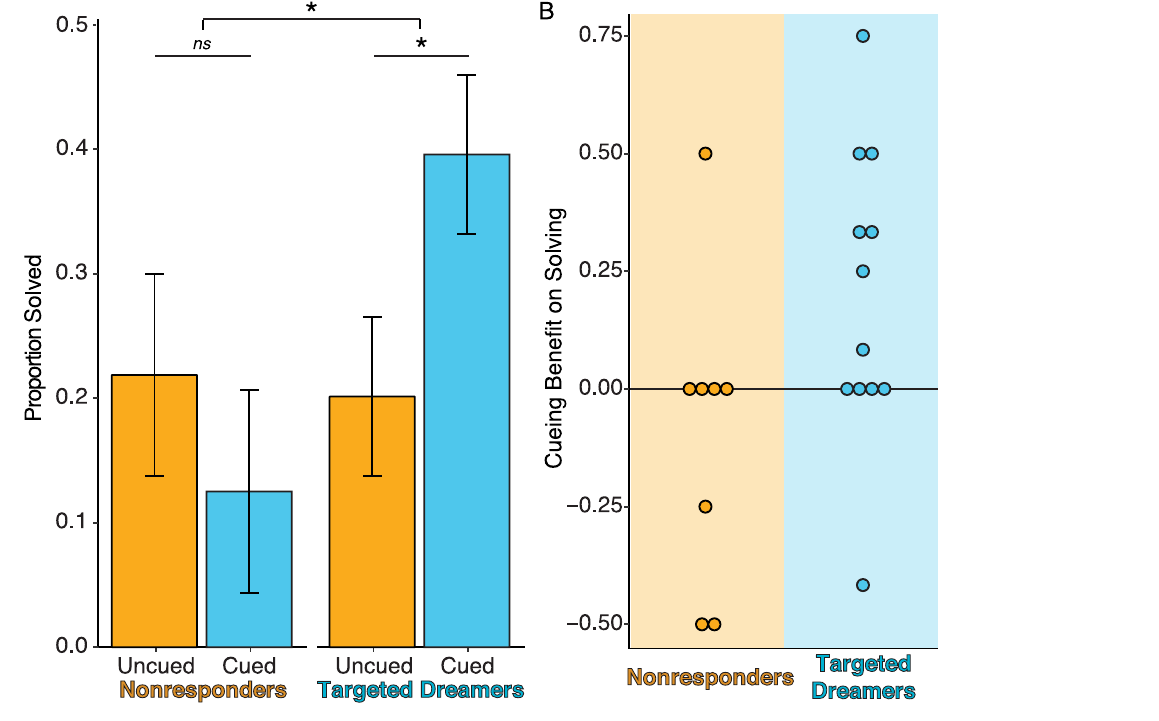
Paper Fig. 5. (A) Cueing raised solving for targeted dreamers but not for non-responders. (B) Each dot is one person’s cueing benefit.
Put together: when a sound managed to steer a dream towards a puzzle, that puzzle was more likely to be solved. When people heard the sound but the puzzle itself never appeared in the dream, there was no benefit. That is a hint that the dream is doing something, not just the sound.
Trying hard, even inside a dream, may not be the best way to have an idea.
The lucid result is the twist. The authors suggest that deliberate effort may drag you back onto the same wrong approach you were stuck on while awake, while ordinary dreams let you forget it and wander towards distant associations.
05
Dream research has a chicken-and-egg problem. People who dream about a task often do better at it the next day, but maybe they dream about it because they were already more engaged. This study flips the direction. By choosing at random which puzzles to play into REM sleep, the team could push dreams towards particular problems and then follow exactly those problems into the morning.
It is also a lovely piece of method. Two-way communication with a sleeping person, sounds going in and eye movements and sniffs coming out, turns the dream from something you describe over breakfast into something you can run an experiment inside.
The catches
Only 20 people and about eight unsolved puzzles each, so the study had little statistical power. Across everyone, the sounds had no reliable effect on solving. The clear benefit only appears after splitting people into targeted dreamers and non-responders, and that split was made after the data came in. The design can’t rule out that people simply thought about a dreamed-of puzzle after waking. Participants knew sounds might be played, and frequent lucid dreamers aren’t typical sleepers. And every puzzle had one right answer, so it says nothing yet about open-ended creativity.
06
Dream engineering, in four steps...
07
“Sleep on it” is advice I have heard my whole life, usually as a polite way of saying “stop thinking about it for now”. What I like about this paper is that it stops treating that advice as folklore and builds an instrument to test it. As an engineer, the part that impressed me most isn’t even the result; it’s the interface. A person in REM sleep can’t speak or move, so the team built a communication protocol out of the only two channels left: the eyes and the breath. That is real-time telemetry from inside a dream.
The finding that surprised me is the lucid one. You would expect being aware inside your dream to be the superpower, the moment you can sit down and deliberately work on the problem. Instead, puzzles that appeared in ordinary dreams were solved more often, and the best rate came from dreams people had already forgotten. I find that oddly comforting. Sometimes the most useful thing your brain can do with a problem is to stop holding it so tightly.
I wouldn’t plan an exam around it yet: twenty people, a handful of puzzles each, and the clearest effect only shows up after splitting the group. But as a first step it is exactly the kind of experiment I enjoy. Take an old anecdote, design a clever rig, and make the question measurable. Next time I am stuck on a design problem, I might just go to bed.
← Back to all talks
Discussion
Register with your email to join the discussion
{{cm.err}}
{{cm.err}}
No comments yet. Be the first to share your thoughts.
{{c.text}}