In Big Hero 6, Hiro Hamada walks into a university showcase with a bucket of microbots: tiny identical robots that click together into whatever he imagines. A bridge, a wave, a giant hand. What makes the idea so good is that there is no single robot. There is a kit, and the shape is whatever the job needs.
This paper is the closest real thing I have seen to that idea. A team led from Northwestern University built a robot leg that is also a whole robot: one motor, its own battery, its own computer, able to jump, roll and turn on its own. Bolt a few together and they become a new animal, with a body a computer designed and a brain trained in simulation. They are definitely not micro. But they are a real step towards that kit.
Per module. Each one is a complete robot on its own.
How high a single module can jump.
Possible bodies you can bolt together from five modules.
Controllers trained in simulation worked outdoors first try.
01
Look at legged robots from the last ten years and you mostly see two shapes: four legs or two. Animals, meanwhile, have rearranged and reshaped legs into millions of body plans. Robots that can be reconfigured do exist, but the legs usually hang off a central torso that holds the battery, computer and motors. Damage the torso and the whole thing stops, and most of those robots are slow, weak, and stay indoors.
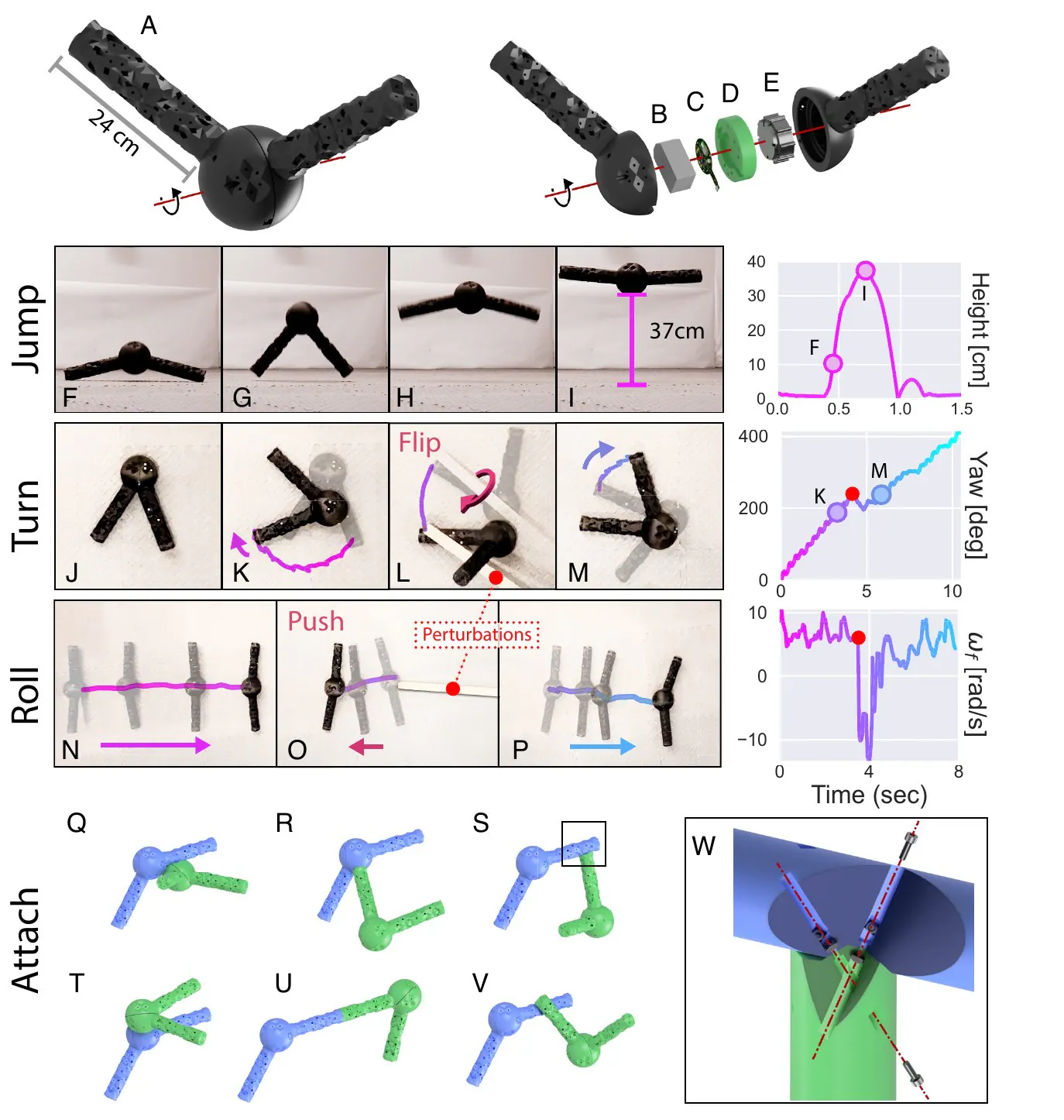
The team flipped the idea. Here, every leg is the robot. Each module is a sphere with two 24 cm links sticking out of it, joined by a single motor. Everything else (battery, circuit board, sensors, Wi-Fi) is packed inside the sphere. On its own, one module can already do three tricks.
Asking a fixed-shape robot to become something else
One body plan, decided at the factory. It politely declines.
The two links rotate around an axis set at 63.5°, so one motor can sweep them through a full cone. Watch it jump, roll and turn, then look inside; pick a scene to pause on it.
Lying flat, the module whips its motor round so fast that the links slam down into a V and fling the sphere 37 cm into the air, higher than one and a half link lengths.
02
Along the outside of every module are 18 honeycomb-shaped docks: four on the sphere, six along each link, one at each tip. Two modules can be bolted together at any pair of docks, in three orientations, with ordinary M4 screws and nuts. The joints are strong enough for acrobatics: they were tested to 150 Nm of torque, 3.5 kN of tension and 4 kN of shear.
That is where the numbers explode. Two modules can be joined in 435 distinct ways. Every extra module multiplies the options.
At one body per second, about 3,500 years. Hence the machine learning.
You can’t test a hundred billion robots. So the team let a computer choose.
03
The design loop has three pieces of machine learning, each doing one job:
Three modules
Four modules
Five modules
04
Four bodies were built: the best three-, four- and five-module designs found by the computer, plus a quadruped designed by hand, with one module acting as a moving spine. Trained only on a flat simulated floor, they were tested outside on brick paths, grass, plant litter, gravel, sand, mud, tree roots and pavers.
The gaits they found look strangely familiar. The hand-built quadruped bends its spine and sprawls like a lizard. The three-module design moves like a seal: it can’t pull its hind flippers forward, so it galumphs. The four-module design settled into a three-legged gait, like an animal that has lost a leg. Nobody asked for any of these; they fell out of the body plus the training.
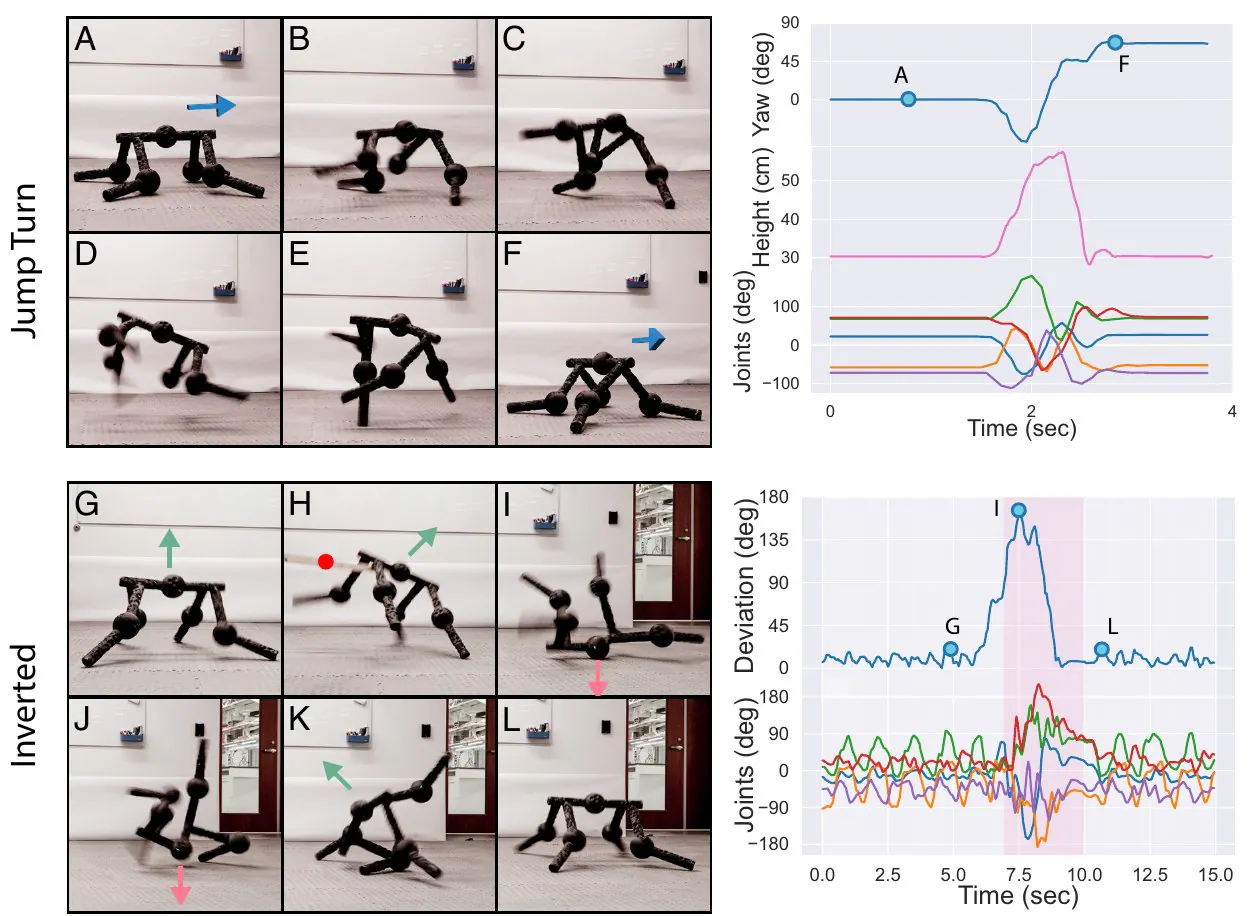
They also learned tricks. On command, the five-module robot jumps and spins 66° in mid-air, and when flipped upside down it twists itself back over and carries on walking. A single module is less capable: it can roll over concrete and bricks, but grass defeats it.
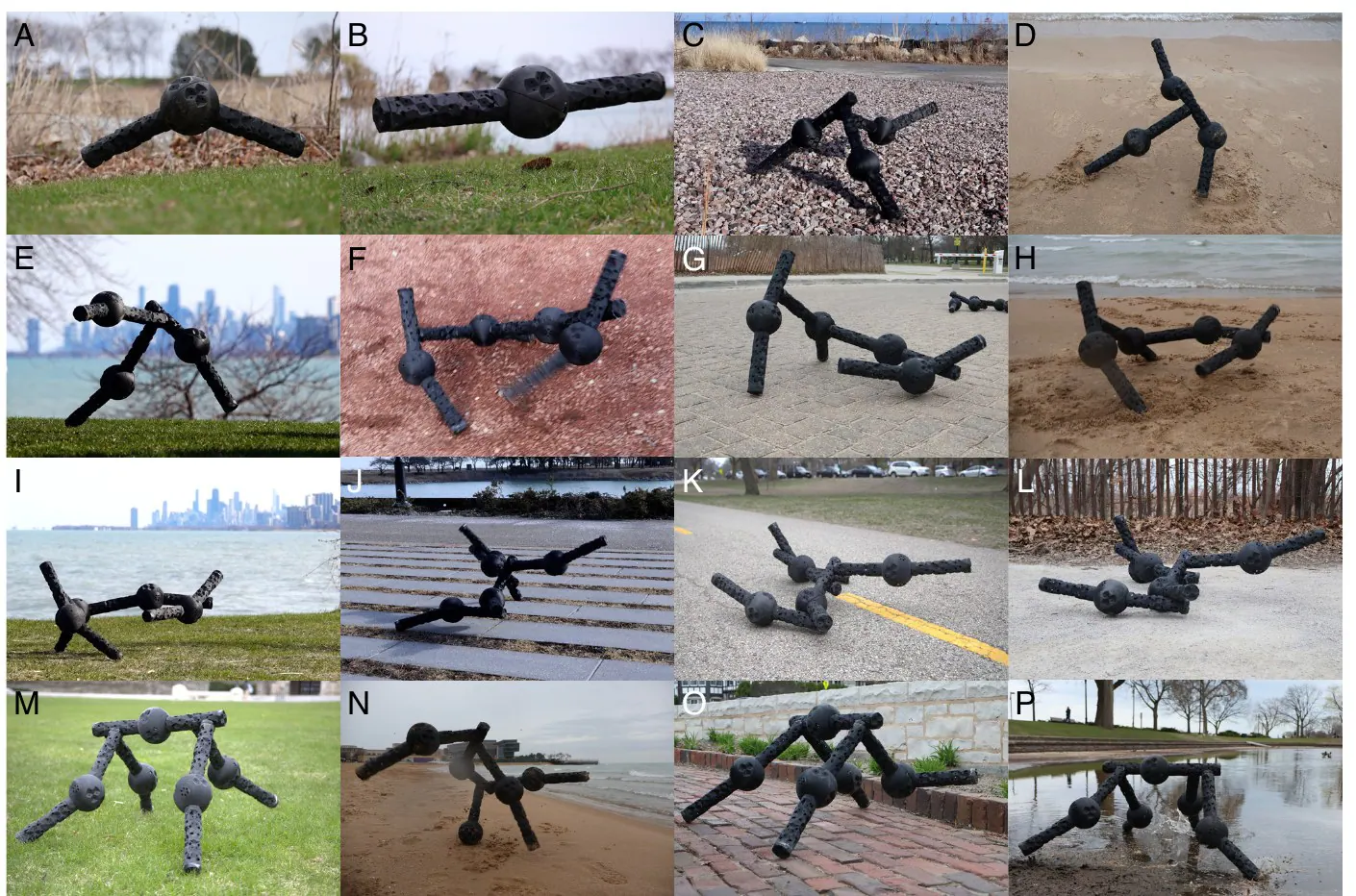
Paper Fig. 1. Robots built from the same modules, outdoors. (A, B) A single module. (C–E) The three-module design. (F–I) Four modules. (J–L) Five modules. (M–P) The hand-designed quadruped. Fully extended, one module is 62 cm long.
05
Most robots have a single point of failure. Take out the part with the battery and the brain, and they are done. Here, every module carries its own, so the body can lose pieces and what remains is still a working machine. The question is whether the controller can cope.
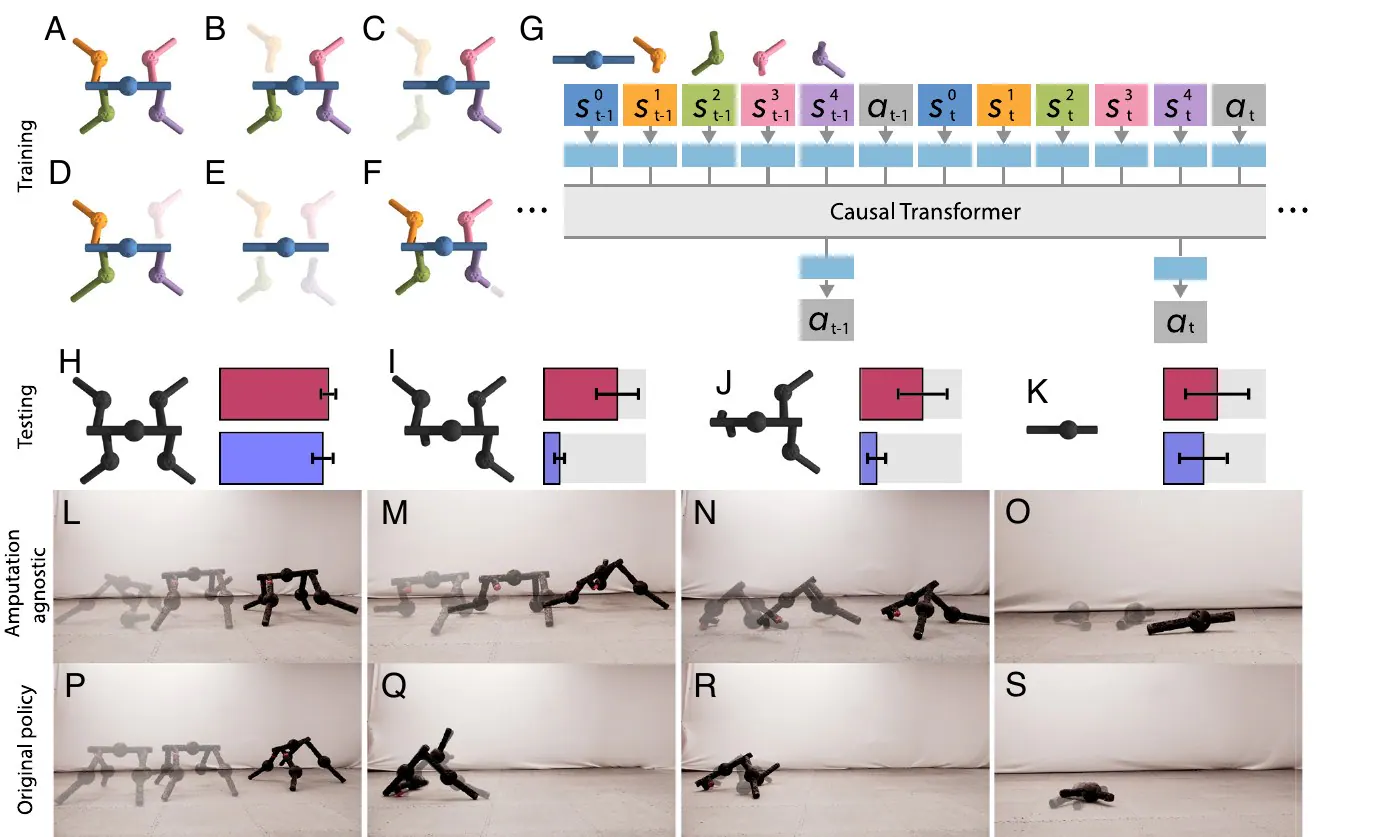
To find out, the team trained “expert” controllers for the quadruped with one, two or four legs removed, and recorded what each one sensed and did. Then they trained a single transformer, the same kind of model behind language AIs, to predict the next action from recent sensor readings. It is never told which modules are missing. It has to work it out from how its body is responding.
With nothing missing, the new damage-proof controller walks just as well as the original one: 105.3% of its speed.
06
Robotics has two branches that rarely meet: agile legged robots, which are fast but come in fixed shapes, and reconfigurable robots, which change shape but are slow and fragile. This paper joins them. It shows modular robots that are agile enough to run outdoors, and a design pipeline that can turn a box of parts into a working new body quickly.
It also changes who can do robot design. All the electronics live in the sphere, and the links are inert printed tubes held on by screws. Anyone with a 3D printer and a screwdriver can swap in a new link shape. The authors imagine standardised, mass-produced modules that let people anywhere build and test new agile robots, a bit like LEGO for walking machines. The code is public on GitHub.
The catches
The robots can’t yet rebuild themselves: a person still bolts the modules on and off. Controllers run on a nearby computer over Wi-Fi, though the authors say they are small enough to run on the module’s own chip. Each module is 62 cm long and weighs about 1.4 kg, a long way from micro. Only four bodies were built and tested. And the design map isn’t perfect: feed it the hand-designed quadruped and it gives back a slightly different robot, with the forelegs shifted and an extra spine module.
07
Build-your-own robot animal, in four steps...
08
The first thing I thought of when I saw these robots was Hiro’s microbots from Big Hero 6. The look is similar: identical dark pieces that click into a new body for every job. That’s where the title comes from. These modules are 62 cm long and bolted together by hand, so they are not micro, not swarming, and not controlled by thought. But the idea underneath, many identical parts that become whatever shape the job needs, is the same one, and this is the first time I have seen it run outside on real ground.
As someone who has spent a lot of hours with a 3D printer and a screwdriver, the design choice I love most is the simplest one. Everything clever lives inside the sphere, and the links are just printed tubes. That means the shape of the robot is no longer locked inside an expensive, sealed product; it is something you can redesign over a weekend. Pair that with a computer that searches for good bodies, and the slow part of robot design is no longer the engineer.
To get from here to real microbots, the list is long: shrink the modules, let them find and dock with each other on their own, maybe with magnets instead of screws, and control hundreds at once. None of that is in this paper. But every one of those steps needs a module that can already move on its own and a way to design bodies faster than humans can. That part now exists. Not quite micro, but definitely a step.
← Back to all talks

Discussion
Register with your email to join the discussion
No comments yet. Be the first to share your thoughts.
In Big Hero 6, Hiro Hamada walks into a university showcase with a bucket of microbots: tiny identical robots that click together into whatever he imagines. A bridge, a wave, a giant hand. What makes the idea so good is that there is no single robot. There is a kit, and the shape is whatever the job needs.
This paper is the closest real thing I have seen to that idea. A team led from Northwestern University built a robot leg that is also a whole robot: one motor, its own battery, its own computer, able to jump, roll and turn on its own. Bolt a few together and they become a new animal, with a body a computer designed and a brain trained in simulation. They are definitely not micro. But they are a real step towards that kit.
Per module. Each one is a complete robot on its own.
How high a single module can jump.
Possible bodies you can bolt together from five modules.
Controllers trained in simulation worked outdoors first try.
01
Look at legged robots from the last ten years and you mostly see two shapes: four legs or two. Animals, meanwhile, have rearranged and reshaped legs into millions of body plans. Robots that can be reconfigured do exist, but the legs usually hang off a central torso that holds the battery, computer and motors. Damage the torso and the whole thing stops, and most of those robots are slow, weak, and stay indoors.
The team flipped the idea. Here, every leg is the robot. Each module is a sphere with two 24 cm links sticking out of it, joined by a single motor. Everything else (battery, circuit board, sensors, Wi-Fi) is packed inside the sphere. On its own, one module can already do three tricks.
Asking a fixed-shape robot to become something else
One body plan, decided at the factory. It politely declines.
The two links rotate around an axis set at 63.5°, so one motor can sweep them through a full cone. Watch it jump, roll and turn, then look inside; pick a scene to pause on it.
Lying flat, the module whips its motor round so fast that the links slam down into a V and fling the sphere 37 cm into the air, higher than one and a half link lengths.
The sphere has a 7 cm radius and weighs 980 g; each link is 24 cm long, weighs 194 g and is 3D printed in carbon-fibre-filled nylon (PAHT-CF). A soft rubbery sock on each tip adds grip and cuts noise. The motor is an off-the-shelf Xiaomi CyberGear with 12 Nm peak torque, running from a 1300 mAh six-cell battery that lasts several hours. Because the axis crosses the links at 63.5°, rotating the motor sweeps the links around the biggest possible cone. Bend them slightly and the centre of mass moves off the contact point, so the module starts to roll; snap the motor round quickly and it jumps.
The controllers only use the module’s own senses: the joint encoder and an inertial measurement unit. Motion capture cameras were used to measure the robots indoors, never to steer them.

Paper Fig. 2. (A–E) One module: battery, circuit board, holder and motor inside the sphere. (F–I) Jumping 37 cm. (J–M) Turning, even after being flipped over. (N–P) Rolling, and recovering from a push. (Q–W) Two modules can dock in 435 different ways.
02
Along the outside of every module are 18 honeycomb-shaped docks: four on the sphere, six along each link, one at each tip. Two modules can be bolted together at any pair of docks, in three orientations, with ordinary M4 screws and nuts. The joints are strong enough for acrobatics: they were tested to 150 Nm of torque, 3.5 kN of tension and 4 kN of shear.
That is where the numbers explode. Two modules can be joined in 435 distinct ways. Every extra module multiplies the options.
{{n.note}}
You can’t test a hundred billion robots. So the team let a computer choose.
03
The design loop has three pieces of machine learning, each doing one job:
Three modules
Four modules
Five modules
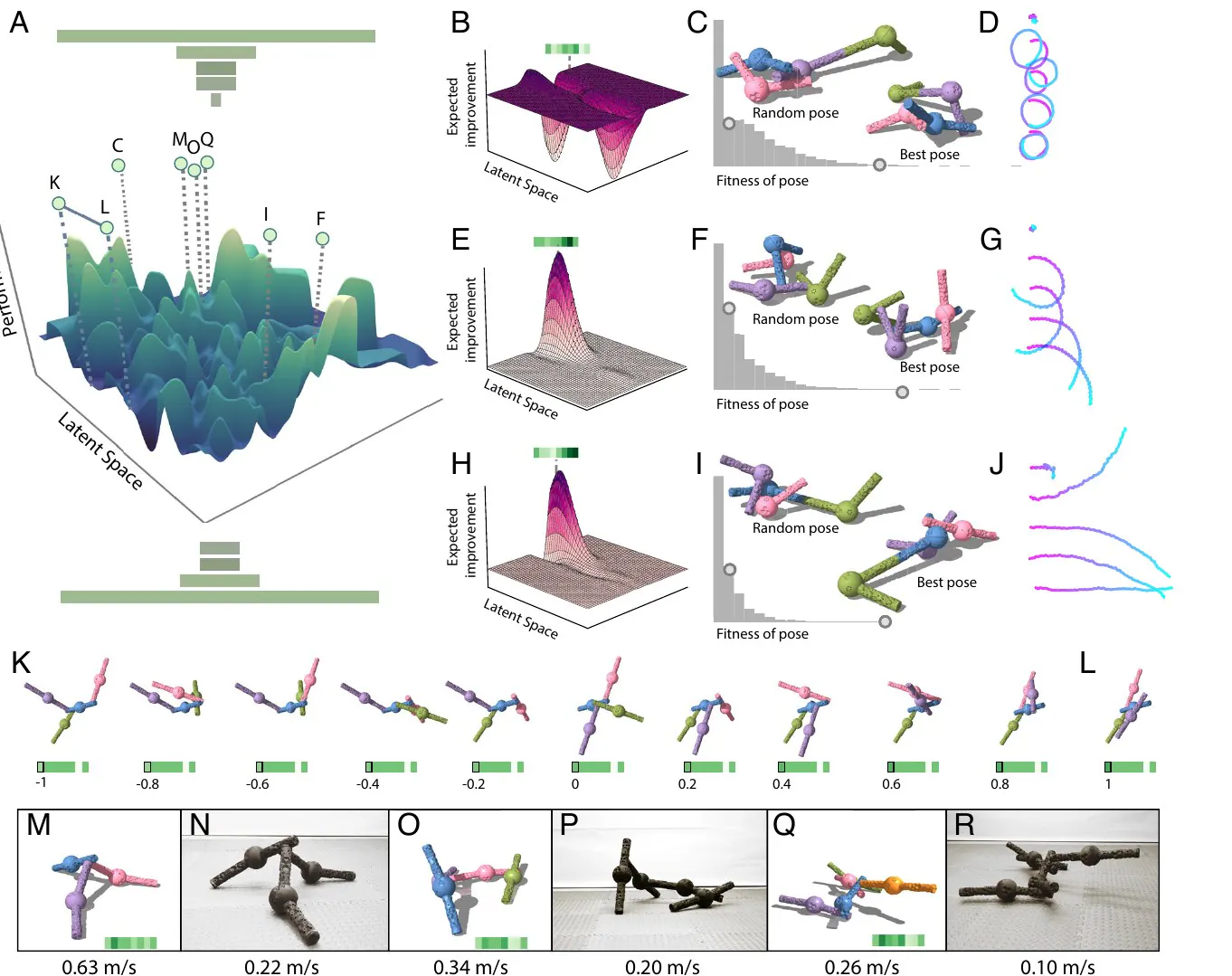
Each body is stored as a list of 16 numbers (which module, which dock, which child module, which orientation, for every joint). About 70% of random bodies could reach a resting pose without parts colliding, and those were used to train the autoencoder. For every candidate body, 4,096 random starting poses were tried in simulation with a simple wiggle signal; the pose with the widest footprint that moved furthest without falling became the starting point for training. One problem the simulator had to learn: the robots are steered from a nearby computer over Wi-Fi, so the delay was built into training too.

Paper Fig. 4. (A) Performance across a 2D slice of the 8-dimensional design map. (B–J) Bayesian optimisation picking promising bodies, choosing their poses and training them. (K–L) Sliding smoothly between two designs on the map. (M–R) The three optimised designs, in simulation and in reality.
04
Four bodies were built: the best three-, four- and five-module designs found by the computer, plus a quadruped designed by hand, with one module acting as a moving spine. Trained only on a flat simulated floor, they were tested outside on brick paths, grass, plant litter, gravel, sand, mud, tree roots and pavers.
The gaits they found look strangely familiar. The hand-built quadruped bends its spine and sprawls like a lizard. The three-module design moves like a seal: it can’t pull its hind flippers forward, so it galumphs. The four-module design settled into a three-legged gait, like an animal that has lost a leg. Nobody asked for any of these; they fell out of the body plus the training.
They also learned tricks. On command, the five-module robot jumps and spins 66° in mid-air, and when flipped upside down it twists itself back over and carries on walking. A single module is less capable: it can roll over concrete and bricks, but grass defeats it.

Paper Fig. 1. Robots built from the same modules, outdoors. (A, B) A single module. (C–E) The three-module design. (F–I) Four modules. (J–L) Five modules. (M–P) The hand-designed quadruped. Fully extended, one module is 62 cm long.
Every multi-module design in the paper learned to self-right. The jump-turn policy listens for a command, pushes off, rotates the body 66° clockwise in the air and lands upright; the self-righting policy notices from its tilt sensor that it is upside down and contorts its body until it is the right way up. Once again, all of this runs on the robot’s own sensors.

Paper Fig. 3. (A–F) A jump-turn on command. (G–L) Flipped over with a wooden plank, it twists back upright and resumes walking.
05
Most robots have a single point of failure. Take out the part with the battery and the brain, and they are done. Here, every module carries its own, so the body can lose pieces and what remains is still a working machine. The question is whether the controller can cope.
To find out, the team trained “expert” controllers for the quadruped with one, two or four legs removed, and recorded what each one sensed and did. Then they trained a single transformer, the same kind of model behind language AIs, to predict the next action from recent sensor readings. It is never told which modules are missing. It has to work it out from how its body is responding.
{{q.note}}
The transformer was trained by distillation: it learns to imitate the experts across all their damage scenarios, much like a language model learns grammar by predicting the next word. On the intact robot it walked at 105.3% of the original controller’s speed. On three damage cases it had never seen exactly (one hind limb cut at a random point, both hind limbs removed, and everything gone except one module), it consistently moved further forward than the original controller.

Paper Fig. 5. (A–F) Training scenarios. (G) The causal transformer predicts the next action from recent sensations and actions. (H–K) Forward travel for the new policy (red) and original (blue) on the intact and damaged robot. (L–S) The new policy keeps moving where the original stalls or tips.
06
Robotics has two branches that rarely meet: agile legged robots, which are fast but come in fixed shapes, and reconfigurable robots, which change shape but are slow and fragile. This paper joins them. It shows modular robots that are agile enough to run outdoors, and a design pipeline that can turn a box of parts into a working new body quickly.
It also changes who can do robot design. All the electronics live in the sphere, and the links are inert printed tubes held on by screws. Anyone with a 3D printer and a screwdriver can swap in a new link shape. The authors imagine standardised, mass-produced modules that let people anywhere build and test new agile robots, a bit like LEGO for walking machines. The code is public on GitHub.
The catches
The robots can’t yet rebuild themselves: a person still bolts the modules on and off. Controllers run on a nearby computer over Wi-Fi, though the authors say they are small enough to run on the module’s own chip. Each module is 62 cm long and weighs about 1.4 kg, a long way from micro. Only four bodies were built and tested. And the design map isn’t perfect: feed it the hand-designed quadruped and it gives back a slightly different robot, with the forelegs shifted and an extra spine module.
07
Build-your-own robot animal, in four steps...
08
The first thing I thought of when I saw these robots was Hiro’s microbots from Big Hero 6. The look is similar: identical dark pieces that click into a new body for every job. That’s where the title comes from. These modules are 62 cm long and bolted together by hand, so they are not micro, not swarming, and not controlled by thought. But the idea underneath, many identical parts that become whatever shape the job needs, is the same one, and this is the first time I have seen it run outside on real ground.
As someone who has spent a lot of hours with a 3D printer and a screwdriver, the design choice I love most is the simplest one. Everything clever lives inside the sphere, and the links are just printed tubes. That means the shape of the robot is no longer locked inside an expensive, sealed product; it is something you can redesign over a weekend. Pair that with a computer that searches for good bodies, and the slow part of robot design is no longer the engineer.
To get from here to real microbots, the list is long: shrink the modules, let them find and dock with each other on their own, maybe with magnets instead of screws, and control hundreds at once. None of that is in this paper. But every one of those steps needs a module that can already move on its own and a way to design bodies faster than humans can. That part now exists. Not quite micro, but definitely a step.
← Back to all talks
Discussion
Register with your email to join the discussion
{{cm.err}}
{{cm.err}}
No comments yet. Be the first to share your thoughts.
{{c.text}}