A fruit fly’s brain is smaller than a poppy seed, yet it lets the fly see, smell, walk, fly, court and remember. For decades, scientists could only study it a few neurons at a time. A connectome changes that: it is a complete wiring diagram, every neuron and every connection between them, traced from electron microscope images.
This month I’m reviewing three papers that form a neat sequence. The first maps a whole adult fly brain. The second runs that map as a computer model and checks whether it behaves like a real fly. The third maps a whole male nervous system, brain and nerve cord, and compares it with the female brain from the first paper. Together they show what a wiring diagram can and can’t tell you about a brain.
Neurons in the first whole adult fly brain map.
Of human proofreading time behind it, shared across labs and volunteers.
Of the brain model’s tested predictions matched real flies.
Of male central brain neurons are male-specific or dimorphic.
01 · Paper A
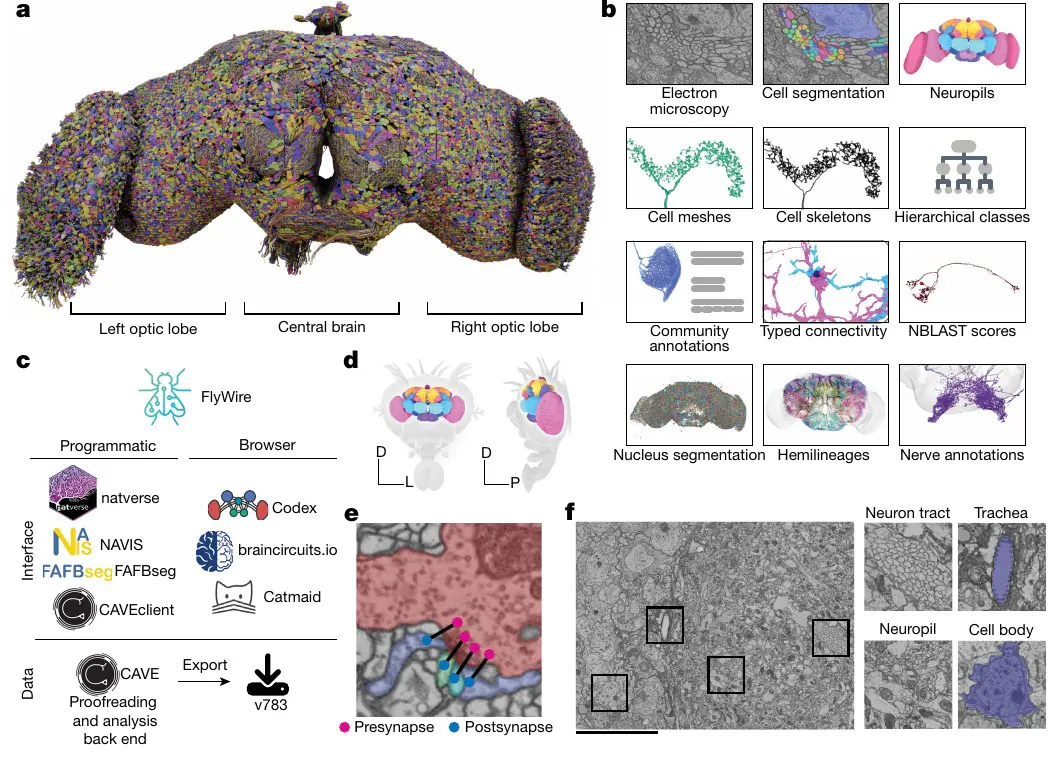
The raw material was already public: a female fly brain cut into thousands of slices about 40 nanometres thick, each photographed with an electron microscope. The FlyWire team aligned the images, let neural networks trace every neuron automatically, and then had people fix the mistakes. That proofreading took an estimated 33 person-years, shared between research labs, central teams at Princeton and Cambridge, and citizen scientists around the world. Synapses and the likely chemical messenger (neurotransmitter) of each neuron were predicted by separate machine-learning tools.
The result: 139,255 neurons and 54.5 million synapses between them, plus annotations for more than 8,400 cell types in a companion paper. It is the first wiring diagram of an entire adult brain, and it was open to the community while it was still being built.

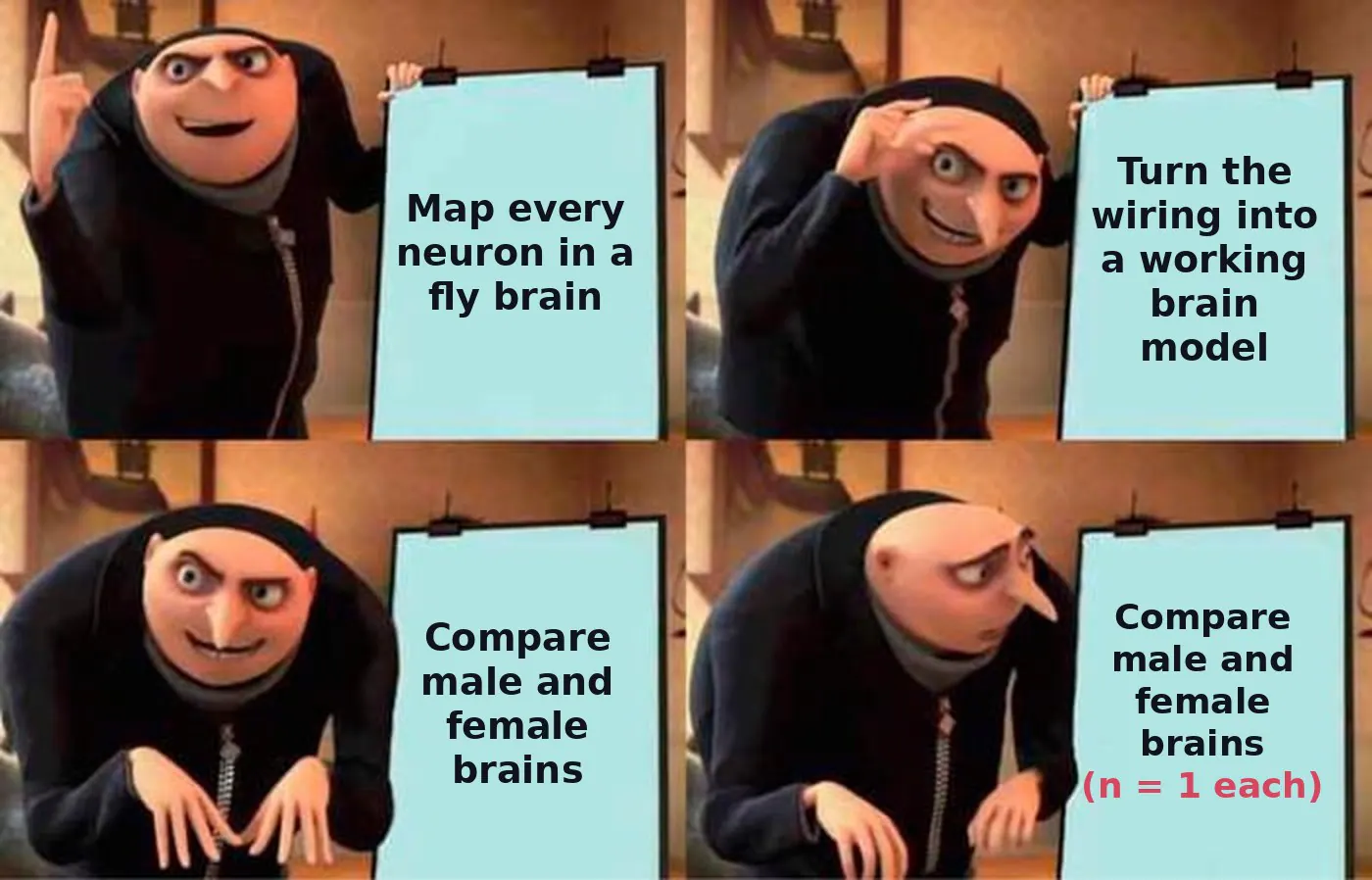
Me explaining 54.5 million synapses
Every red string is a connection. Counting only strong ones, there are still about 2.7 million.
The worm connectome (1986) had about 300 neurons. Paper A has 139,255 in one brain; Paper C adds the nerve cord for 166,700.
Some findings simply come from finally having the whole thing. 85% of the brain’s neurons are “intrinsic”: they start and end inside the brain, so the brain mostly talks to itself. Synapses are packed at 7.4 per cubic micrometre, several times denser than mammalian cortex. Most neurons belong to the optic lobes, a reminder that the fly is a very visual animal. And the brain constantly talks back to its eyes: about half of all optic lobe neurons get at least five synapses from just 524 neurons coming back from the central brain.
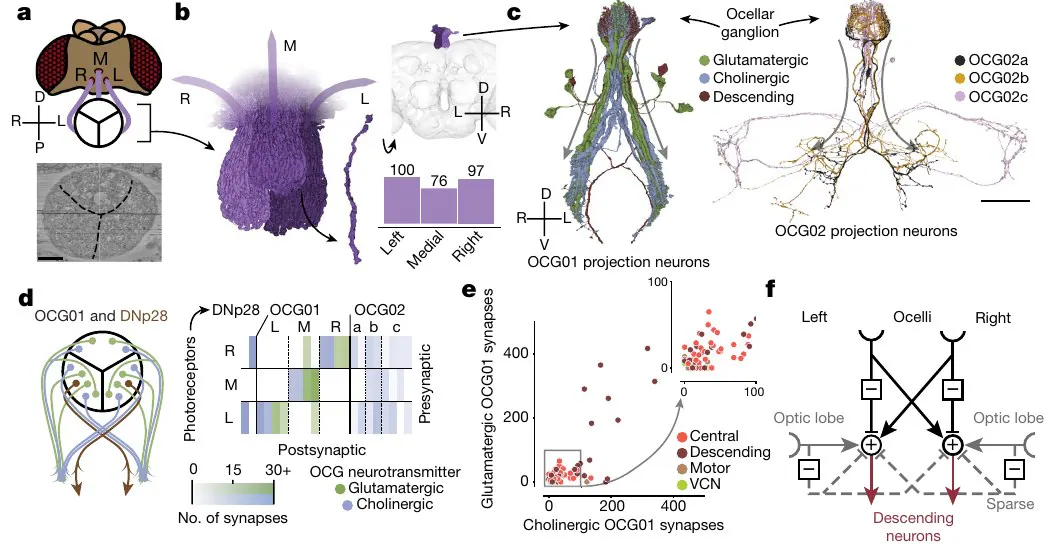
The authors also show how to use the map. Following the wiring from the three small ocelli on top of the fly’s head (simple light-sensing eyes) down to the neurons that leave the brain, they find each side excited by the opposite ocellus and inhibited by its own. That arrangement would roll the fly towards the light, like a simple robot that steers by comparing two light sensors. It is a hypothesis, generated purely from wiring, that experiments can now test.
02 · Paper B
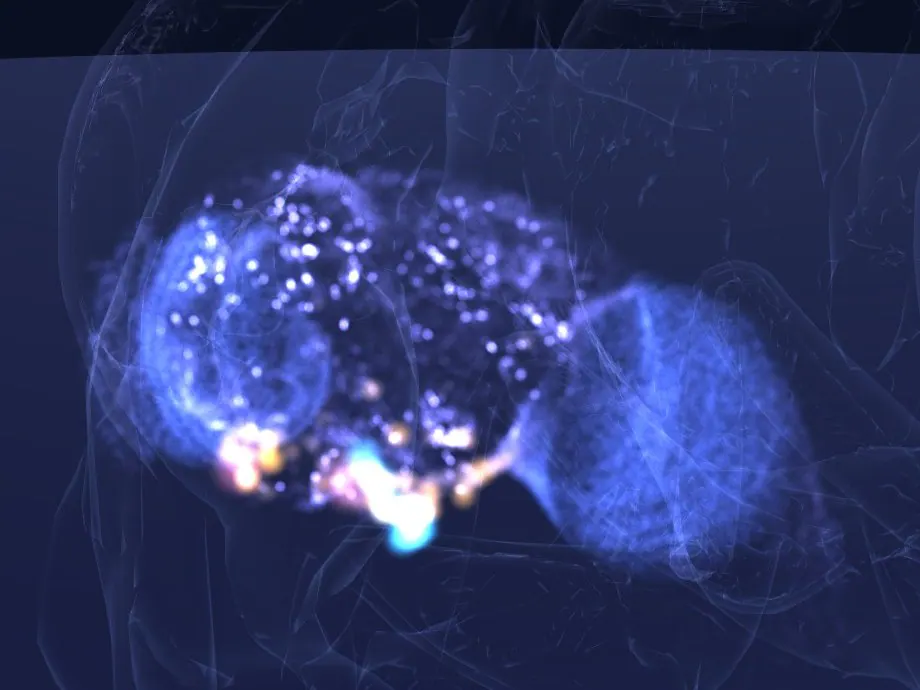
A wiring diagram is a static object. The second paper asks a bold question: what if you simply turn it on? The team, led from UC Berkeley, gave every one of 127,400 FlyWire neurons the simplest reasonable behaviour, a “leaky integrate-and-fire” neuron that adds up inputs, slowly forgets them, and fires a spike when it crosses a threshold. Each synapse pushes the next neuron up or down depending on the predicted neurotransmitter, with strength proportional to the synapse count. Almost every number came from earlier fly studies; only one, the size of a single synapse’s push, was tuned.

The model, after loading 54.5 million synapses
No training, one tuned number. Then it started predicting what real flies do.
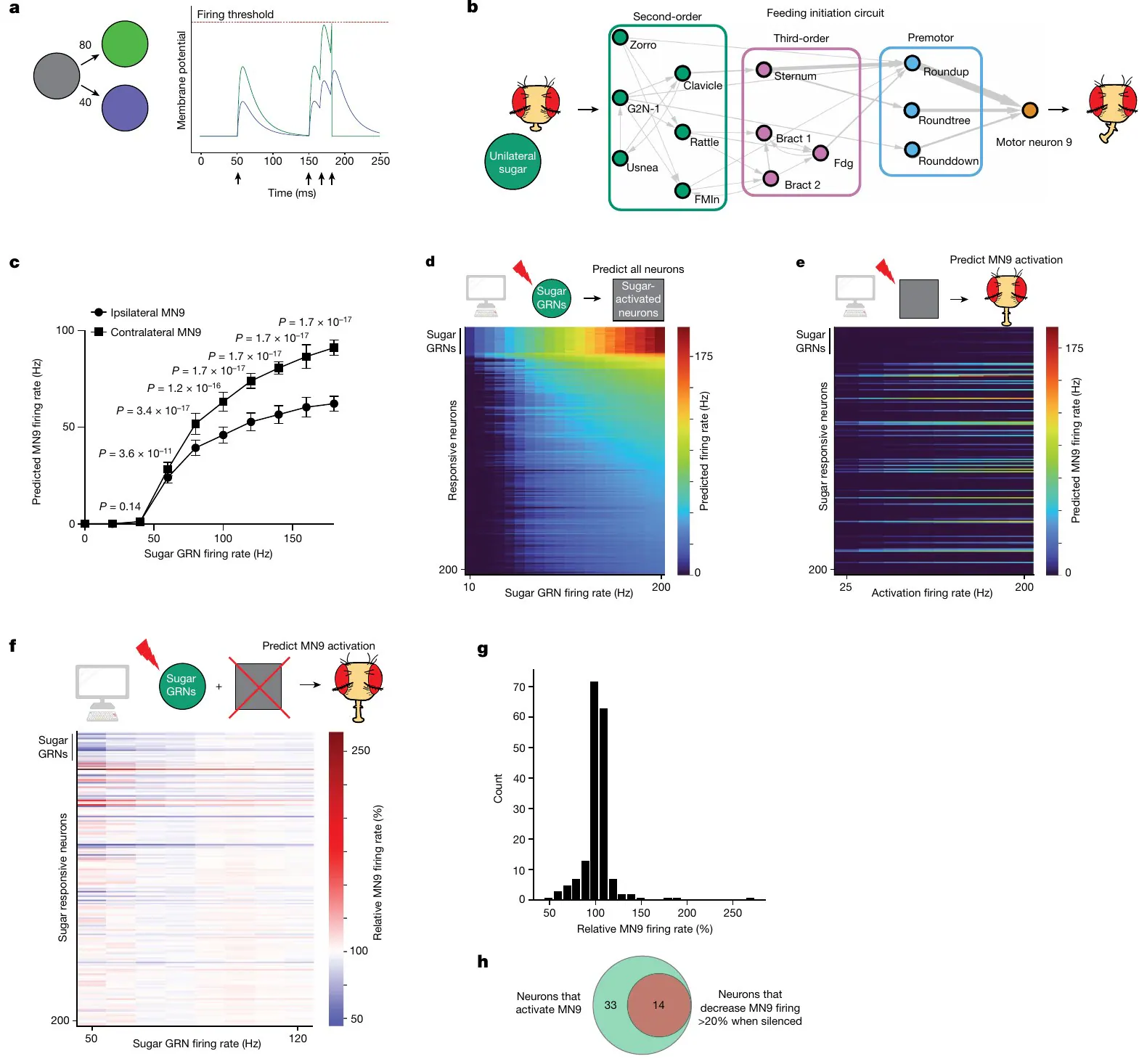
Then they poked it. Activating sugar-sensing taste neurons in the model switched on the motor neuron (MN9) that lifts the proboscis, the fly’s mouth, exactly as sugar does in real flies. Shuffle the wiring while keeping the same set of weights, and that happened in only 1 of 100 runs: the result depends on the real map, not just its statistics.
A taste neuron type thought to be attractive. The model said it suppresses feeding; flies agreed.
Neurons shared by the sugar and water pathways, but only 2 shared with bitter.
Touch neurons wired to a grooming neuron that still fail to drive it. Imaging confirmed it.
The most convincing test was a screen the model couldn’t have been tuned for. The team optogenetically switched on 106 different cell types in real flies, one at a time, and watched for proboscis extension, then compared that with what the model predicted for the same cell types. Across all 164 predictions they could test, 91% matched. That number deserves a closer look.
The paper’s headline: of 164 predictions they could check in real flies, 91% were consistent with the results.

When “always say no” scores 87%
A good reminder to ask what an accuracy number is being compared against.
03 · Paper C
The FlyWire brain stops at the neck. Paper C, from Janelia and Cambridge, images an entire male central nervous system, brain plus nerve cord (the fly’s spinal cord), with seven focused-ion-beam microscopes running for 13 months at 8 nanometres in every direction. After 44 person-years of proofreading it contains 166,700 neurons sorted into 11,710 cell types. 97.9% of neurons were matched to cell types in earlier datasets, so the paper also works as a “Rosetta Stone” for fly neuron names.
The bigger prize is a comparison. With a male and a female brain mapped to the same detail, the team sorted every cell type into four groups: isomorphic (the same in both sexes), dimorphic (present in both but shaped differently), and male-specific or female-specific. They found 8,069 isomorphic, 138 dimorphic, 289 male-specific and 71 female-specific types.

Male and female flies, comparing their 8,069 shared cell types
Almost everything matches. The interesting part is the small slice that doesn’t.
About 5% of male central brain neurons are male-specific or dimorphic, and another 6.9% look identical to the female version but are wired differently. In the optic lobes, by contrast, only 0.4% of male neurons differ at all.
The pattern is striking. Sex differences are almost absent at the edges: the senses and the motor neurons are largely the same in both sexes, and in the optic lobes only 0.1% of male neurons are male-specific. They concentrate instead in higher, integrative centres, deeper in the network. Measured in steps from the senses, isomorphic neurons sit at layer 3.9 on average, sex-specific ones at 4.3 and dimorphic ones at 4.5. Even neurons that look identical can be wired differently: 6.9% of male central brain neurons have sex-specific connections despite no visible difference in shape.
Some circuits read like stories. Shared visual neurons that look at the front of the visual field feed male-specific circuits that lead to courtship steering, a kind of “love spot” without a special eye. Male song neurons in the nerve cord send copies back up to the brain’s song-detection circuits, which could let a male tell his own song from a rival’s. And just 4 of 60 smell-receptor types are more numerous in males, three of them pheromone detectors.
04
These aren’t three separate stories. Paper B is built directly on Paper A’s map, and Paper C uses Paper A’s brain as its female reference and points to whole-brain simulations like Paper B as the way to test what its sex differences actually do. Map, run, compare: each step only became possible because the one before it was shared openly.
| A · Map | B · Run | C · Compare | |
|---|---|---|---|
| Question | What is connected to what, across a whole brain? | If you only know the wiring, can you predict what the brain does? | What is different between a male and a female nervous system? |
| Animal and region | One adult female fly: brain and both optic lobes | The same female brain (FlyWire), simulated | One adult male fly: brain, optic lobes and nerve cord |
| Scale | 139,255 neurons · 54.5 million synapses | 127,400 model neurons | 166,700 neurons · 11,710 cell types |
| Method | Thin-slice electron microscopy, AI segmentation, 33 person-years of proofreading | Leaky integrate-and-fire spiking model with one free parameter, tested with optogenetics | Block-face electron microscopy at 8 nm, 44 person-years of proofreading, matched to FlyWire |
| Headline | The first wiring diagram of a whole adult brain, open to everyone | 91% of 164 tested predictions matched experiments | Sex differences sit in higher brain centres, not at the senses or muscles |
| Biggest limit | Chemical synapses only; most input synapses are not attached to a neuron | No neuromodulators, gap junctions or resting activity | One male compared with one female |
A connectome tells you who can talk to whom. It doesn’t tell you who is talking, how loudly, or what the chemicals floating around are saying.
05
Neuroscience has mostly worked backwards, recording a few neurons and guessing the circuit around them. Whole connectomes flip that: you can start from the complete circuit, form a hypothesis (the ocellar steering circuit, the courtship love spot, the song feedback loop) and then go and test it. Paper B shows the hypotheses can be surprisingly good even from a crude model, and that a computer can run thousands of experiments before anyone touches a fly.
The methods also scale. FlyWire’s tools have already been used on millimetre-sized pieces of mammalian brain, and a project to map a whole mouse brain has begun. Paper C’s approach of comparing whole nervous systems, using the left and right sides as a check on noise, is a template for asking how brains differ between individuals, sexes, species, or experiences.

Galaxy brain: next stop, bigger brains
A human brain has roughly 86 billion neurons, about 600,000 times as many as a fly’s. A whole human connectome is still a long way off.
The catches
One of each. Paper A is one female brain, Paper C is one male. Differences between them mix sex with individual variation and with technical differences between two imaging methods. Paper C handles this carefully, but it is still a comparison of two animals.
What the maps miss. Only chemical synapses are counted; gap junctions are invisible. Fewer than half of input sites are attached to a neuron, so weak connections are uncertain. Neurotransmitters are predicted from images, not measured, and neuromodulators are absent.
How to read 91%. Paper B’s screen is dominated by cell types that don’t trigger feeding, so a model that always answered “no” would still score about 87% there. The more telling figures are that 10 of the 11 “yes” predictions came true, and 10 of the 14 real hits were found. The model also struggled with neurons that inhibit inhibitors or rely on neuropeptides.
Snapshots. Each connectome is one moment in one animal’s life, so learning, hunger and mood leave no trace.
06
Map it, run it, compare it...
07
What impresses me most here isn’t any single number. It is the way the work was done in the open. FlyWire let other labs use the map while it was still being proofread, citizen scientists did real work, and the next two papers could exist only because the first one was shared. That is how infrastructure should be built.
The result I find most surprising is Paper B. A model that ignores neuron shape, chemistry beyond “excite or inhibit”, and everything the fly has learned, with one tuned number, still worked out what a poorly understood taste neuron type does to feeding, and predicted how the grooming circuit responds to different touch neurons. That says a lot about how much of the brain’s logic is written into its wiring. But I also think the 91% headline flatters it a little: in a screen where most answers are “no”, a lazy guess scores almost as well. I would lead with “10 of 11 positive predictions were right”, which is the genuinely impressive part.
Paper C is the one I keep thinking about. The idea that the sexes share the same senses and muscles, and differ mainly in the middle where decisions are made, is elegant and makes evolutionary sense. The authors are careful to say it rests on one animal of each sex. The obvious next steps are more brains, and then running Paper B-style simulations on both sexes to see whether those wiring differences really produce different behaviour.
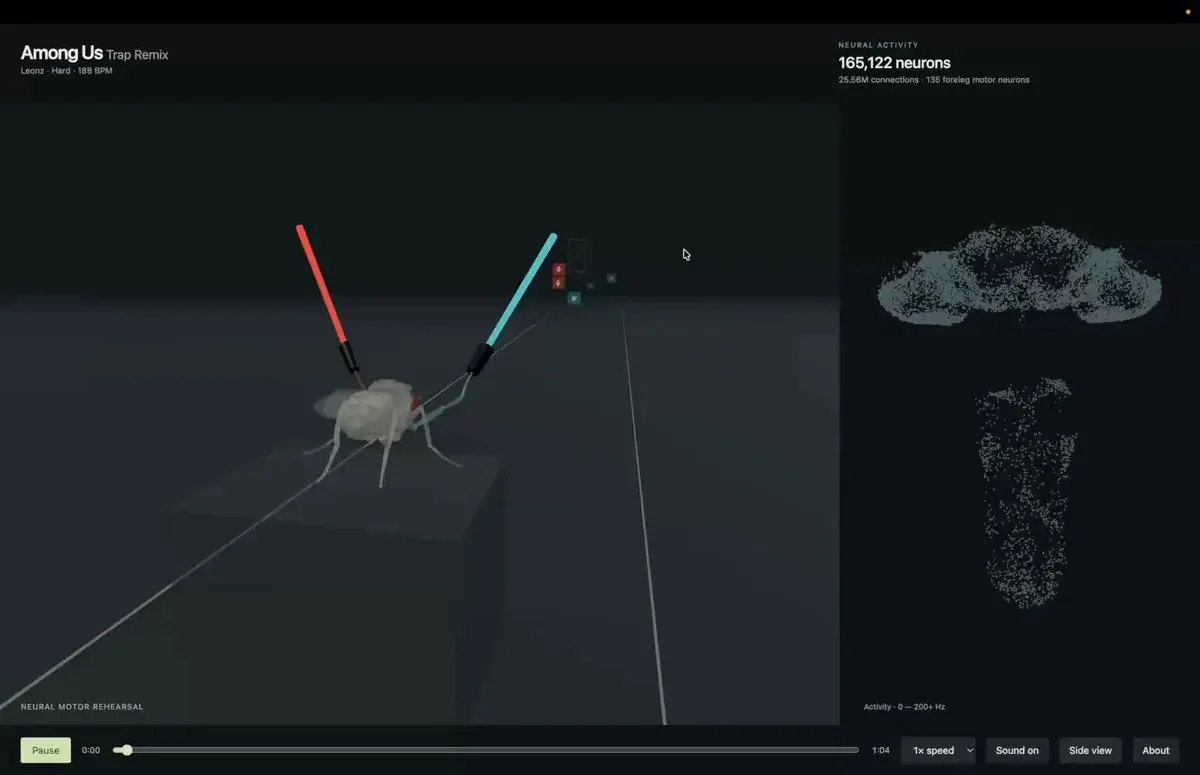
Update, November 2026: I have since run Paper B’s model myself, as a hobby project: A fly’s brain when it tastes sugar? It repeats the paper’s sugar-to-MN9 test, silences Roundup (the pre-motor cell type the paper predicts matters most) and replays every simulated spike in 3D.
← Back to all talksDiscussion
Register with your email to join the discussion
No comments yet. Be the first to share your thoughts.
A fruit fly’s brain is smaller than a poppy seed, yet it lets the fly see, smell, walk, fly, court and remember. For decades, scientists could only study it a few neurons at a time. A connectome changes that: it is a complete wiring diagram, every neuron and every connection between them, traced from electron microscope images.
This month I’m reviewing three papers that form a neat sequence. The first maps a whole adult fly brain. The second runs that map as a computer model and checks whether it behaves like a real fly. The third maps a whole male nervous system, brain and nerve cord, and compares it with the female brain from the first paper. Together they show what a wiring diagram can and can’t tell you about a brain.
Neurons in the first whole adult fly brain map.
Of human proofreading time behind it, shared across labs and volunteers.
Of the brain model’s tested predictions matched real flies.
Of male central brain neurons are male-specific or dimorphic.
01 · Paper A
The raw material was already public: a female fly brain cut into thousands of slices about 40 nanometres thick, each photographed with an electron microscope. The FlyWire team aligned the images, let neural networks trace every neuron automatically, and then had people fix the mistakes. That proofreading took an estimated 33 person-years, shared between research labs, central teams at Princeton and Cambridge, and citizen scientists around the world. Synapses and the likely chemical messenger (neurotransmitter) of each neuron were predicted by separate machine-learning tools.
The result: 139,255 neurons and 54.5 million synapses between them, plus annotations for more than 8,400 cell types in a companion paper. It is the first wiring diagram of an entire adult brain, and it was open to the community while it was still being built.
Me explaining 54.5 million synapses
Every red string is a connection. Counting only strong ones, there are still about 2.7 million.
{{s.note}}
Some findings simply come from finally having the whole thing. 85% of the brain’s neurons are “intrinsic”: they start and end inside the brain, so the brain mostly talks to itself. Synapses are packed at 7.4 per cubic micrometre, several times denser than mammalian cortex. Most neurons belong to the optic lobes, a reminder that the fly is a very visual animal. And the brain constantly talks back to its eyes: about half of all optic lobe neurons get at least five synapses from just 524 neurons coming back from the central brain.
The authors also show how to use the map. Following the wiring from the three small ocelli on top of the fly’s head (simple light-sensing eyes) down to the neurons that leave the brain, they find each side excited by the opposite ocellus and inhibited by its own. That arrangement would roll the fly towards the light, like a simple robot that steers by comparing two light sensors. It is a hypothesis, generated purely from wiring, that experiments can now test.
Accuracy was checked by sending 826 already-proofread neurons for another round; the dataset scored an average F1 of 99.2% by volume. Completeness is uneven, though: 93.7% of output sites (presynapses) are attached to a proofread neuron, but only 44.7% of input sites (postsynapses), because the finest twigs are hard to join up. So the team only counts a connection when there are at least five synapses. That leaves about 2.7 million connections. Electrical synapses (gap junctions) can’t be seen at this resolution and are missing entirely.

Paper A, Fig. 1. (a) Every reconstructed neuron. (b) The data products. (c) Ways to access the data. (d) Brain regions. (e) How a synapse is recorded. (f) The raw electron microscope images.

Paper A, Fig. 7. From the ocelli to descending neurons. (f) The proposed circuit: crossed excitation, same-side inhibition.
02 · Paper B
A wiring diagram is a static object. The second paper asks a bold question: what if you simply turn it on? The team, led from UC Berkeley, gave every one of 127,400 FlyWire neurons the simplest reasonable behaviour, a “leaky integrate-and-fire” neuron that adds up inputs, slowly forgets them, and fires a spike when it crosses a threshold. Each synapse pushes the next neuron up or down depending on the predicted neurotransmitter, with strength proportional to the synapse count. Almost every number came from earlier fly studies; only one, the size of a single synapse’s push, was tuned.
The model, after loading 54.5 million synapses
No training, one tuned number. Then it started predicting what real flies do.
Then they poked it. Activating sugar-sensing taste neurons in the model switched on the motor neuron (MN9) that lifts the proboscis, the fly’s mouth, exactly as sugar does in real flies. Shuffle the wiring while keeping the same set of weights, and that happened in only 1 of 100 runs: the result depends on the real map, not just its statistics.
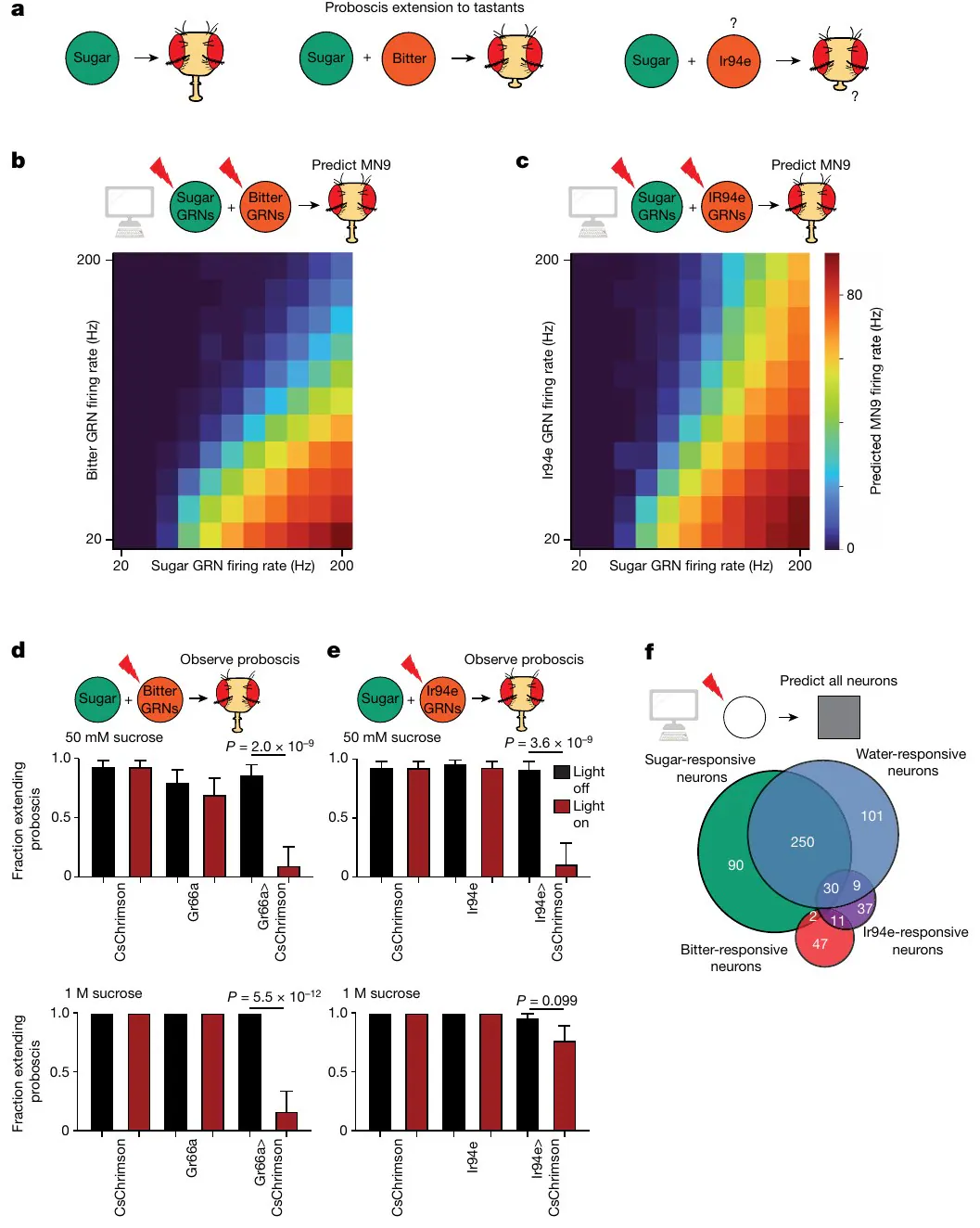
A taste neuron type thought to be attractive. The model said it suppresses feeding; flies agreed.
Neurons shared by the sugar and water pathways, but only 2 shared with bitter.
Touch neurons wired to a grooming neuron that still fail to drive it. Imaging confirmed it.
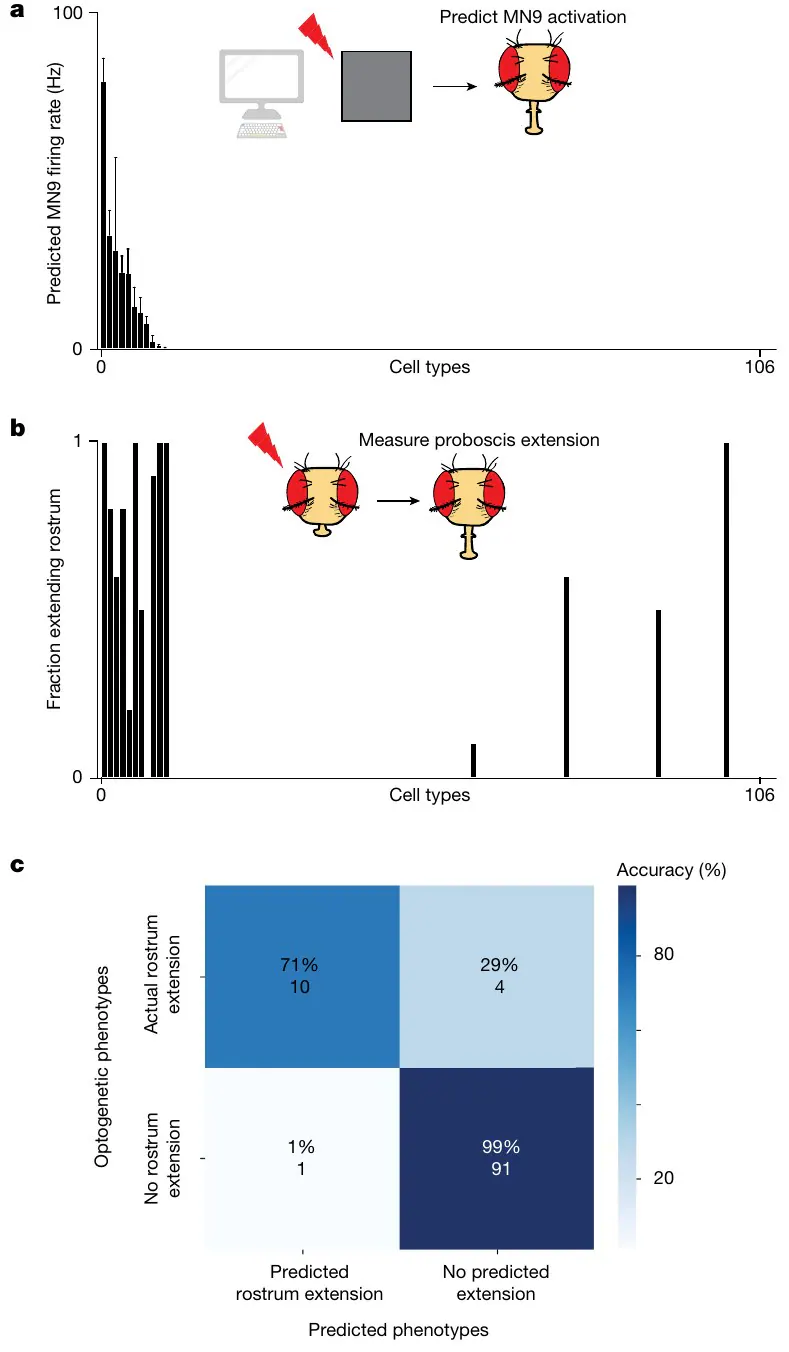
The most convincing test was a screen the model couldn’t have been tuned for. The team optogenetically switched on 106 different cell types in real flies, one at a time, and watched for proboscis extension, then compared that with what the model predicted for the same cell types. Across all 164 predictions they could test, 91% matched. That number deserves a closer look.
{{m.note}}
The model runs in the Brian2 simulator. All neurons rest at 0 Hz, so in the model an inhibitory neuron can only matter if something else is already active. That is exactly where it went wrong: it missed cell types that work by switching off another inhibitory neuron (Phantom), and one that turned out to need neuropeptides (Usnea), which the model ignores. The authors list what is left out: neuron shape, receptor dynamics, gap junctions, non-spiking neurons, internal state such as hunger, and long-range neuropeptides.

Paper B, Fig. 1. (a) How the model works. (b) The sugar-to-proboscis circuit. (c–h) Predicting which neurons respond to sugar and which are needed for MN9 to fire.

Paper B, Fig. 2. The unbiased screen: (a) model predictions, (b) real flies, (c) how they line up.

Paper B, Fig. 3. Ir94e taste neurons suppress feeding, but less strongly than bitter. (f) Overlap of the sugar, water, bitter and Ir94e pathways.
When “always say no” scores 87%
A good reminder to ask what an accuracy number is being compared against.
03 · Paper C
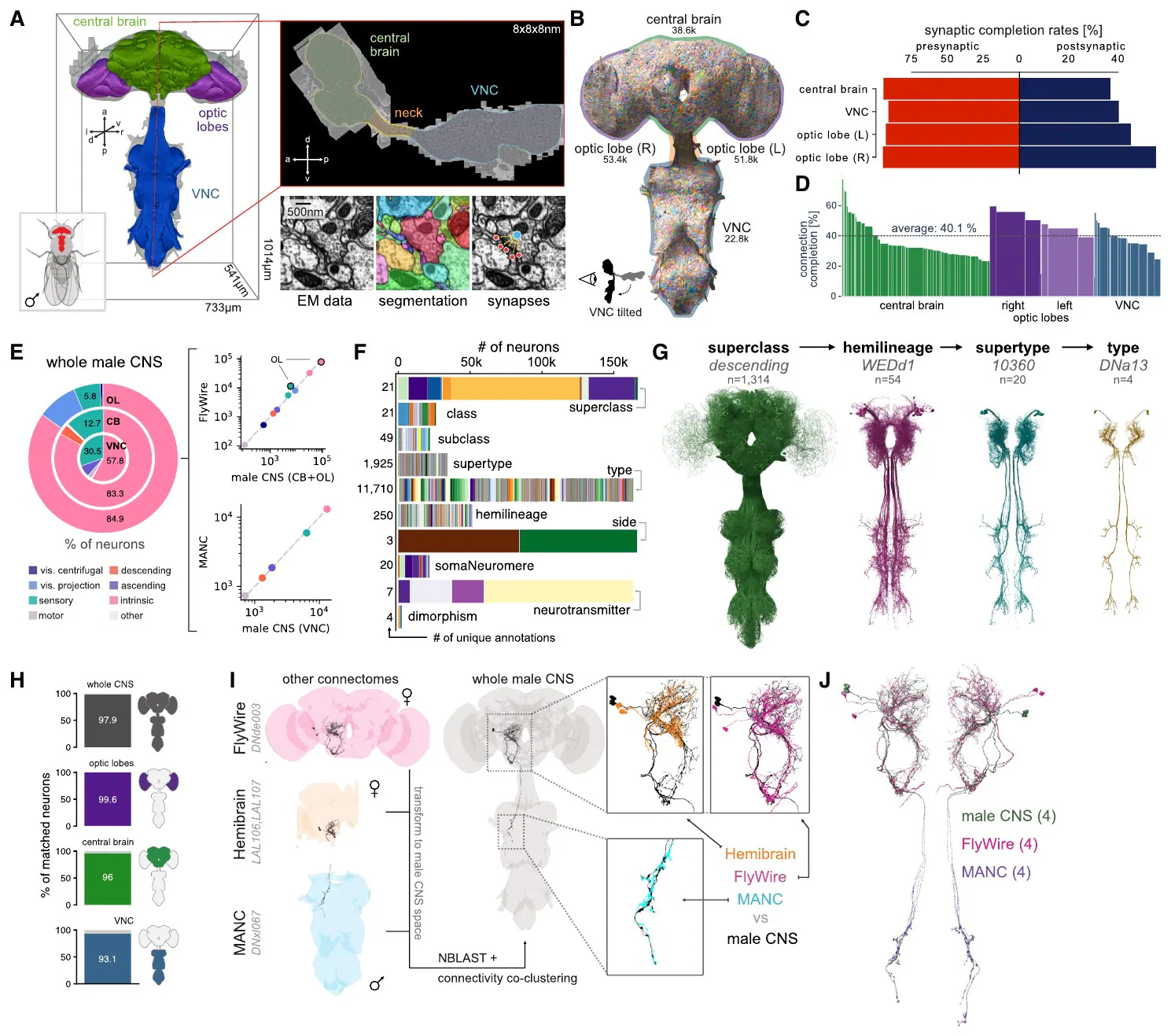
The FlyWire brain stops at the neck. Paper C, from Janelia and Cambridge, images an entire male central nervous system, brain plus nerve cord (the fly’s spinal cord), with seven focused-ion-beam microscopes running for 13 months at 8 nanometres in every direction. After 44 person-years of proofreading it contains 166,700 neurons sorted into 11,710 cell types. 97.9% of neurons were matched to cell types in earlier datasets, so the paper also works as a “Rosetta Stone” for fly neuron names.
The bigger prize is a comparison. With a male and a female brain mapped to the same detail, the team sorted every cell type into four groups: isomorphic (the same in both sexes), dimorphic (present in both but shaped differently), and male-specific or female-specific. They found 8,069 isomorphic, 138 dimorphic, 289 male-specific and 71 female-specific types.
Male and female flies, comparing their 8,069 shared cell types
Almost everything matches. The interesting part is the small slice that doesn’t.
{{d.note}}
The pattern is striking. Sex differences are almost absent at the edges: the senses and the motor neurons are largely the same in both sexes, and in the optic lobes only 0.1% of male neurons are male-specific. They concentrate instead in higher, integrative centres, deeper in the network. Measured in steps from the senses, isomorphic neurons sit at layer 3.9 on average, sex-specific ones at 4.3 and dimorphic ones at 4.5. Even neurons that look identical can be wired differently: 6.9% of male central brain neurons have sex-specific connections despite no visible difference in shape.
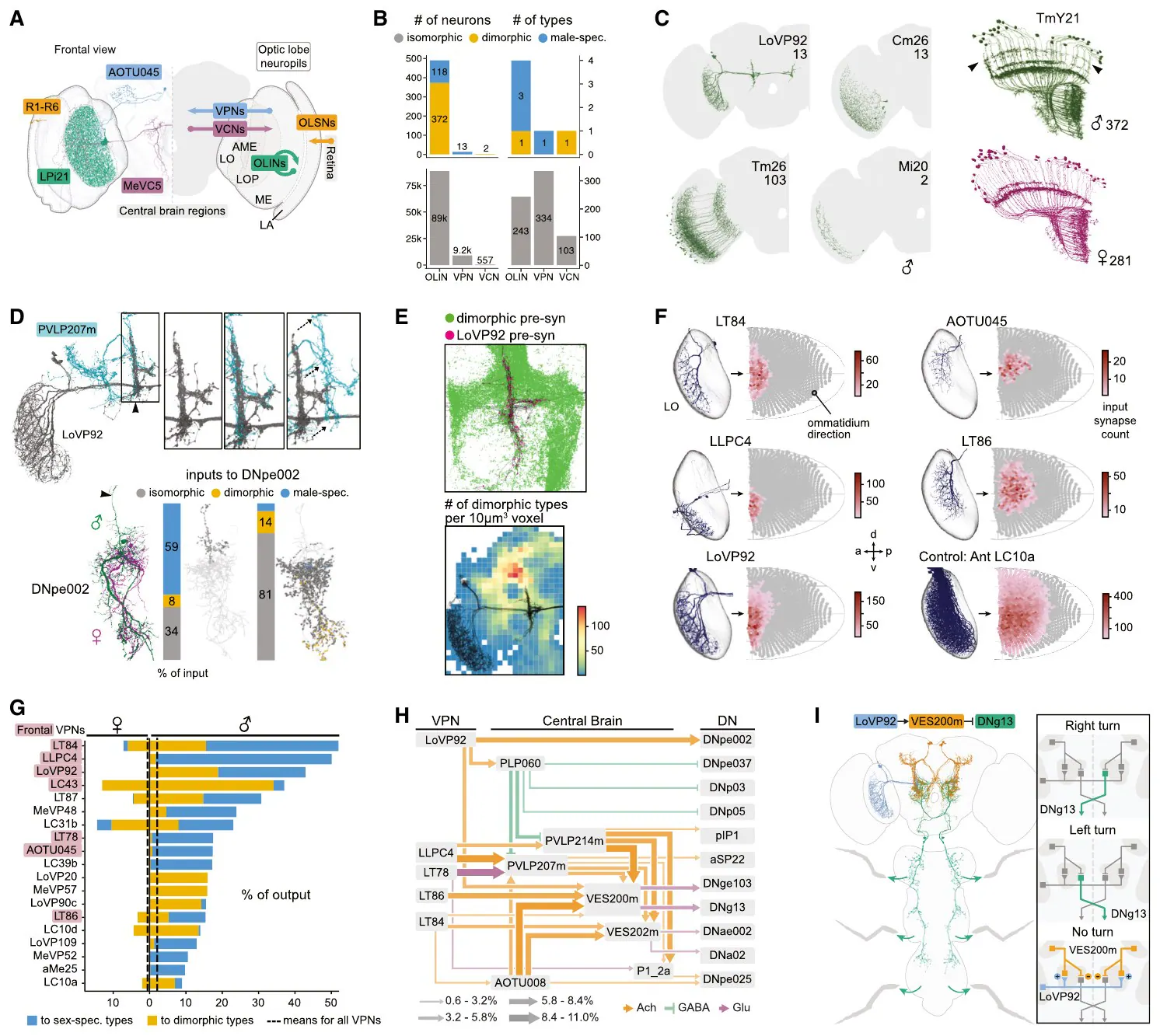
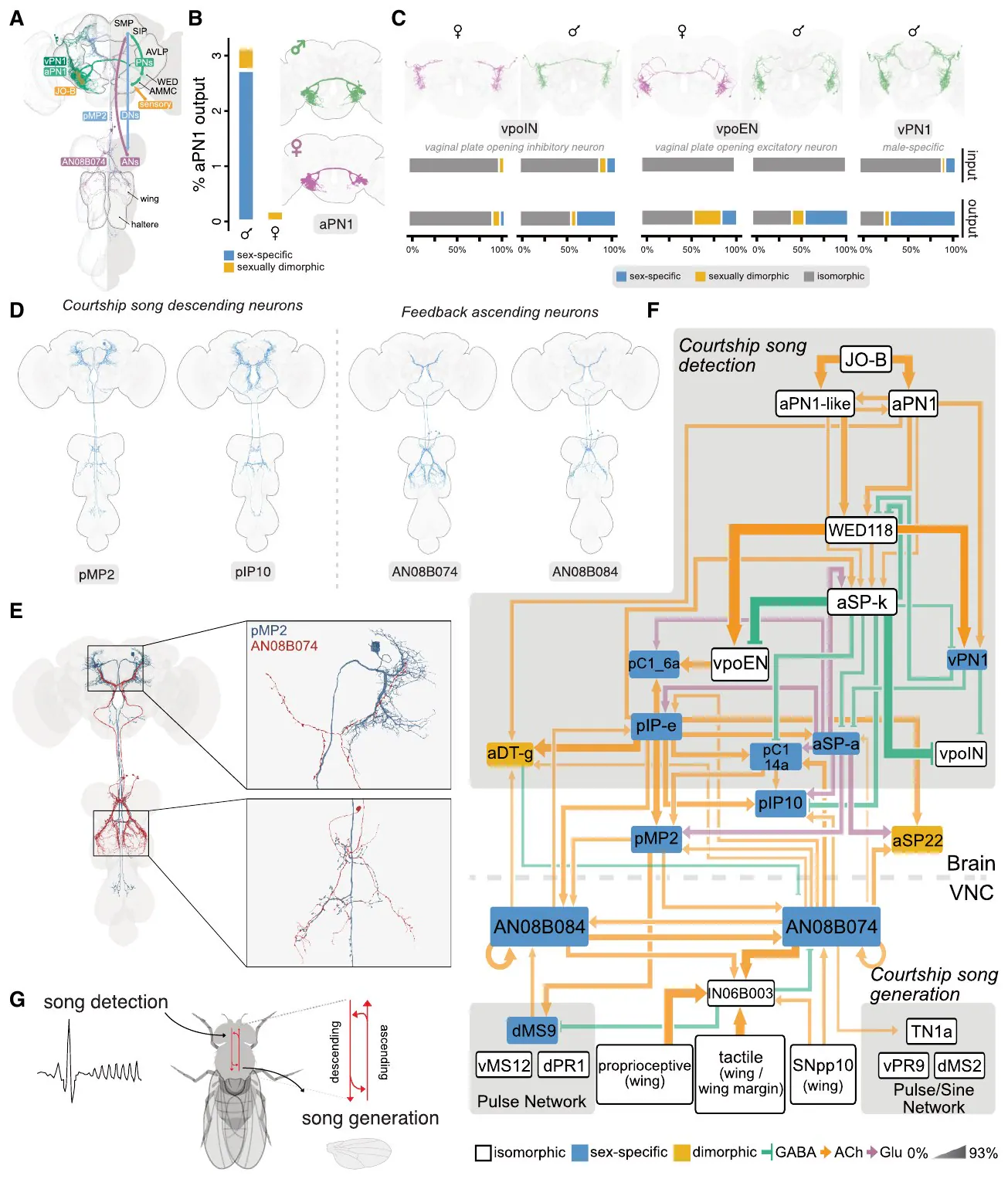
Some circuits read like stories. Shared visual neurons that look at the front of the visual field feed male-specific circuits that lead to courtship steering, a kind of “love spot” without a special eye. Male song neurons in the nerve cord send copies back up to the brain’s song-detection circuits, which could let a male tell his own song from a rival’s. And just 4 of 60 smell-receptor types are more numerous in males, three of them pheromone detectors.
The volume holds 46 million presynapses connected to 312 million postsynapses, detected with a precision and recall of about 0.82 and 0.81. Completion is similar to FlyWire: 94% of presynapses and 42% of postsynapses belong to proofread neurons. Because only one brain of each sex exists, the team could not use ordinary statistics between individuals. Instead they used the left and right sides of each brain as replicates, scaled the male counts to match the female, and only called a connection dimorphic if it differed by at least 30% and passed a false-discovery-rate correction. They write that comparing two raw connectome graphs directly is “unlikely to be successful”.

Paper C, Fig. 1. (A, B) The male CNS volume and every neuron in it. (C, D) Completion rates. (E–G) Annotations. (H–J) Matching to FlyWire, the hemibrain and the male nerve cord dataset.

Paper C, Fig. 4. The visual “love spot”: frontal-looking visual neurons feed sex-specific circuits that reach steering pathways.

Paper C, Fig. 5. A loop between hearing courtship song in the brain and producing it in the nerve cord.
04
These aren’t three separate stories. Paper B is built directly on Paper A’s map, and Paper C uses Paper A’s brain as its female reference and points to whole-brain simulations like Paper B as the way to test what its sex differences actually do. Map, run, compare: each step only became possible because the one before it was shared openly.
| A · Map | B · Run | C · Compare | |
|---|---|---|---|
| Question | What is connected to what, across a whole brain? | If you only know the wiring, can you predict what the brain does? | What is different between a male and a female nervous system? |
| Animal and region | One adult female fly: brain and both optic lobes | The same female brain (FlyWire), simulated | One adult male fly: brain, optic lobes and nerve cord |
| Scale | 139,255 neurons · 54.5 million synapses | 127,400 model neurons | 166,700 neurons · 11,710 cell types |
| Method | Thin-slice electron microscopy, AI segmentation, 33 person-years of proofreading | Leaky integrate-and-fire spiking model with one free parameter, tested with optogenetics | Block-face electron microscopy at 8 nm, 44 person-years of proofreading, matched to FlyWire |
| Headline | The first wiring diagram of a whole adult brain, open to everyone | 91% of 164 tested predictions matched experiments | Sex differences sit in higher brain centres, not at the senses or muscles |
| Biggest limit | Chemical synapses only; most input synapses are not attached to a neuron | No neuromodulators, gap junctions or resting activity | One male compared with one female |
A connectome tells you who can talk to whom. It doesn’t tell you who is talking, how loudly, or what the chemicals floating around are saying.
05
Neuroscience has mostly worked backwards, recording a few neurons and guessing the circuit around them. Whole connectomes flip that: you can start from the complete circuit, form a hypothesis (the ocellar steering circuit, the courtship love spot, the song feedback loop) and then go and test it. Paper B shows the hypotheses can be surprisingly good even from a crude model, and that a computer can run thousands of experiments before anyone touches a fly.
The methods also scale. FlyWire’s tools have already been used on millimetre-sized pieces of mammalian brain, and a project to map a whole mouse brain has begun. Paper C’s approach of comparing whole nervous systems, using the left and right sides as a check on noise, is a template for asking how brains differ between individuals, sexes, species, or experiences.
Galaxy brain: next stop, bigger brains
A human brain has roughly 86 billion neurons, about 600,000 times as many as a fly’s. A whole human connectome is still a long way off.
The catches
One of each. Paper A is one female brain, Paper C is one male. Differences between them mix sex with individual variation and with technical differences between two imaging methods. Paper C handles this carefully, but it is still a comparison of two animals.
What the maps miss. Only chemical synapses are counted; gap junctions are invisible. Fewer than half of input sites are attached to a neuron, so weak connections are uncertain. Neurotransmitters are predicted from images, not measured, and neuromodulators are absent.
How to read 91%. Paper B’s screen is dominated by cell types that don’t trigger feeding, so a model that always answered “no” would still score about 87% there. The more telling figures are that 10 of the 11 “yes” predictions came true, and 10 of the 14 real hits were found. The model also struggled with neurons that inhibit inhibitors or rely on neuropeptides.
Snapshots. Each connectome is one moment in one animal’s life, so learning, hunger and mood leave no trace.
06
Map it, run it, compare it...
07
What impresses me most here isn’t any single number. It is the way the work was done in the open. FlyWire let other labs use the map while it was still being proofread, citizen scientists did real work, and the next two papers could exist only because the first one was shared. That is how infrastructure should be built.
The result I find most surprising is Paper B. A model that ignores neuron shape, chemistry beyond “excite or inhibit”, and everything the fly has learned, with one tuned number, still worked out what a poorly understood taste neuron type does to feeding, and predicted how the grooming circuit responds to different touch neurons. That says a lot about how much of the brain’s logic is written into its wiring. But I also think the 91% headline flatters it a little: in a screen where most answers are “no”, a lazy guess scores almost as well. I would lead with “10 of 11 positive predictions were right”, which is the genuinely impressive part.
Paper C is the one I keep thinking about. The idea that the sexes share the same senses and muscles, and differ mainly in the middle where decisions are made, is elegant and makes evolutionary sense. The authors are careful to say it rests on one animal of each sex. The obvious next steps are more brains, and then running Paper B-style simulations on both sexes to see whether those wiring differences really produce different behaviour.
Update, November 2026: I have since run Paper B’s model myself, as a hobby project: A fly’s brain when it tastes sugar? It repeats the paper’s sugar-to-MN9 test, silences Roundup (the pre-motor cell type the paper predicts matters most) and replays every simulated spike in 3D.
← Back to all talksDiscussion
Register with your email to join the discussion
{{cm.err}}
{{cm.err}}
No comments yet. Be the first to share your thoughts.
{{c.text}}