Pick up a snap hair clip and press it. For a moment it pushes back, then it suddenly gives way with a click and settles in its other shape. Press again and it clicks back. That click is a trick engineers call bistability: a structure with two comfortable resting shapes and an energy hill between them. Push slowly up the hill, and the structure throws itself down the other side far faster than you pushed.
This paper from Columbia University and Texas State University takes that cheap piece of stationery seriously. The team works out the maths of a “hair clip mechanism”, checks it against simulations and experiments, and then turns it into the spine of two robot fish. The faster one, a battery-powered fish with a single motor, swam 2.03 body lengths per second in a lake. Whether that makes it one of the fastest soft robot fish depends, as we will see, on how you measure.
Top speed of the untethered fish, in body lengths per second.
Faster than a conventional twin, in the pneumatic test.
How long a steel hair clip takes to snap across.
A single servo drives the whole tail.
01
What is a hair clip mechanism?
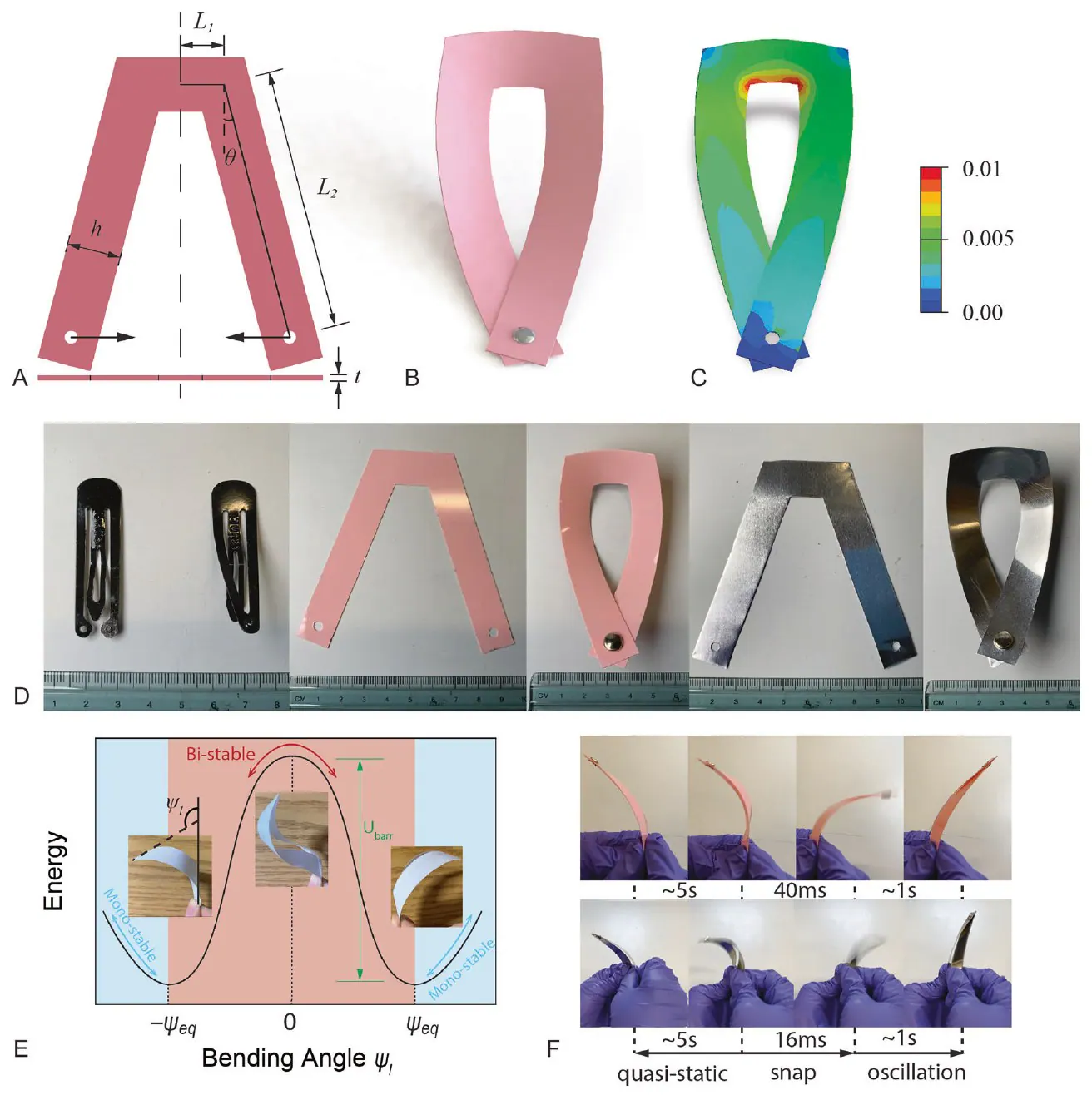
Take a flat ribbon of plastic or steel, cut in the shape of a tall, narrow “A” with a kink at the top. Bring the two feet together and pin them with a rivet. The ribbon can’t stay flat any more, so it buckles and twists into a three-dimensional loop. That loop has two stable shapes, mirror images of each other. To get from one to the other, it has to pass through a strained, high-energy shape in between.
Nature uses the same idea for speed. A Venus flytrap closes by snapping its leaves, and hummingbird beaks and trap-jaw ants use elastic snaps for movements far faster than muscle alone could manage. Soft robots badly need this: they are safe and flexible, but usually slow and weak. A snap lets a slow, gentle actuator store energy and release it all at once.

Nature’s hair clip
A Venus flytrap’s leaves are curved shells that flip from one shape to the other, closing in about a tenth of a second. The same snap-through trick, minus the rivet.
Resting in one valley
The clip sits happily in one of its two shapes. Leave it alone and it stays there, with no power needed.
02
The maths, without the maths
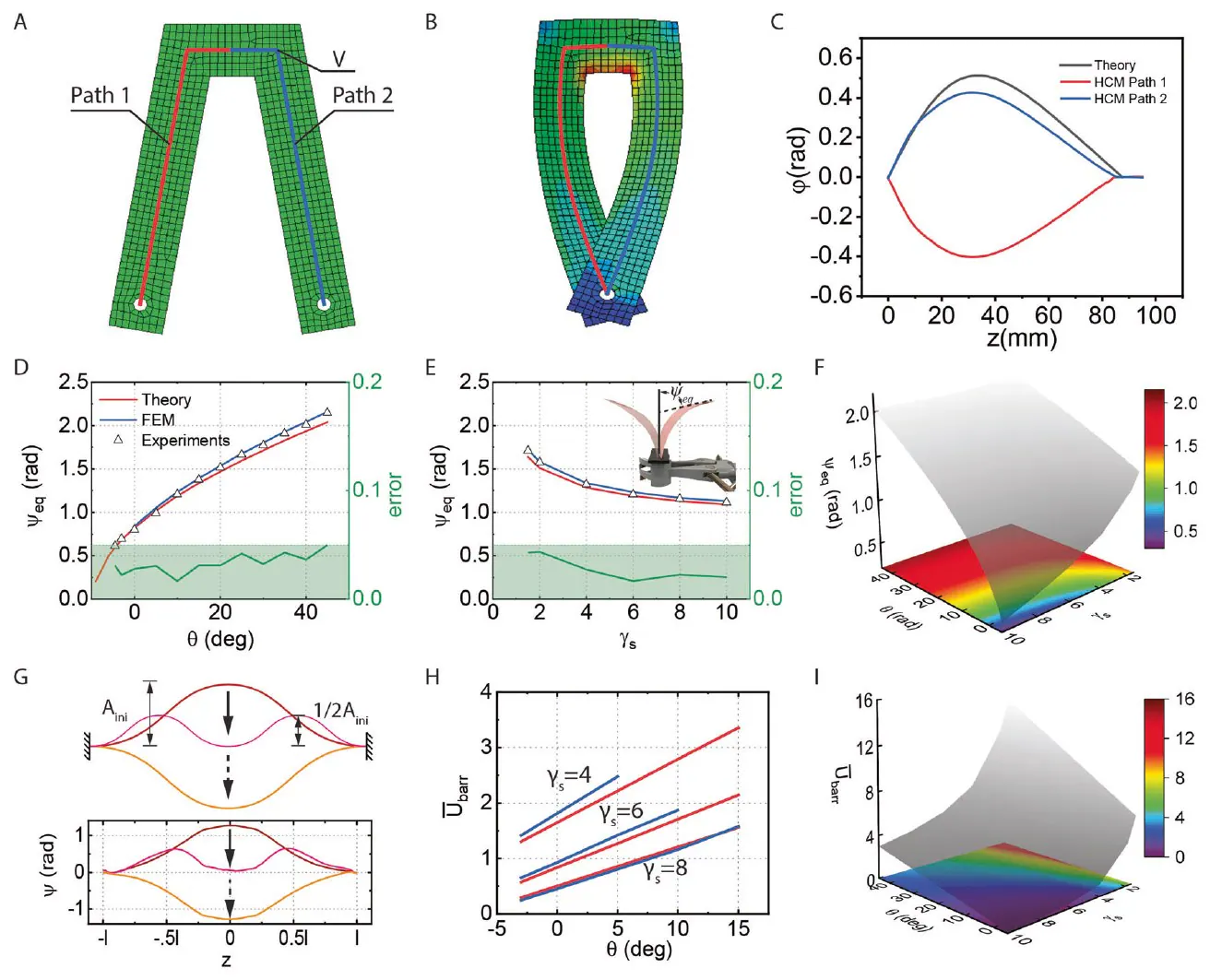
The clip is hard to model because it bends so far, so the team made two simplifying assumptions: treat the kinked ribbon as if it were straight, and treat the bends as small. With those, the twist along the ribbon follows a known mathematical curve (a Bessel function, for the curious), and they could estimate the tail angle, the energy hill between the two states, and how long a snap takes.
The most useful result is a design rule. The shape of the clip at rest depends only on two numbers: the kink angle θ and the ratio of leg length to core length, γs. It doesn’t depend on the material, the thickness or the width, as long as the ribbon is at least ten times wider than it is thick. So you can design a clip once, then scale it up or down, or swap plastic for steel, and keep the same shape.
How close the theory gets. Blue bars: error (scale 0–20%). Orange: predicted vs measured snap time, right order of magnitude but 50–70% too slow.
The authors are refreshingly upfront that the theory is “still qualitative”. It gets the tail angle within about 5% and the energy hill within about 10%, but it overestimates snap times by more than half. That is good enough to choose a design and estimate the fastest a robot could flap, not good enough to replace testing.
03
Fish one: snapping versus bending
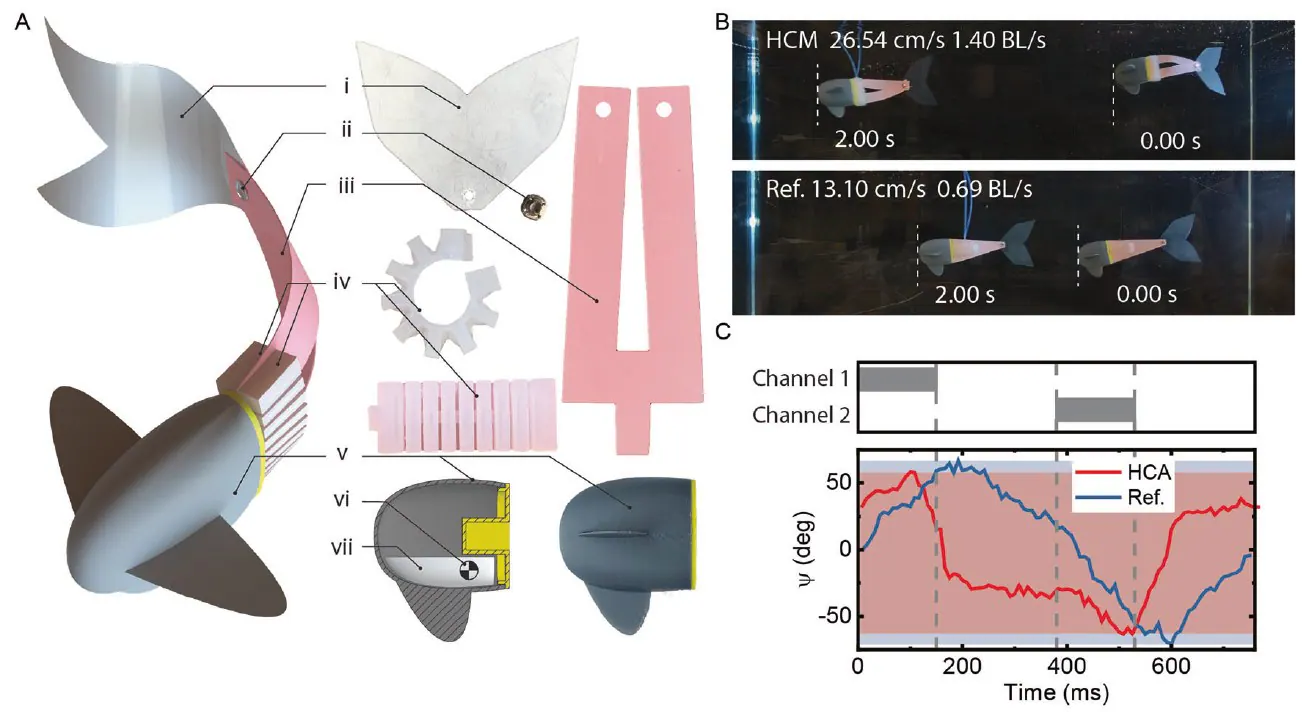
Real fish like mackerel and tuna swim “carangiform”: the front of the body stays fairly still and a wave of bending runs back to a stiff, flicking tail. A snapping clip, released at one end, sends just that kind of wave along its length. So the first robot uses a plastic clip as the fish’s body, with a 3D-printed head and a thin plastic tail fin riveted on.

Fish one, conceptually
Give a clip a head and a tail fin, and as far as the water can tell, yes.
Two small air-powered bending actuators sit either side of the clip. Inflate one and the clip snaps one way; inflate the other and it snaps back. For a fair-ish test, the team also built a conventional fish of the same size and almost the same weight, where the same actuators simply bend a flat plastic strip from side to side.
Swimming speed: 1.40 vs 0.69 BL/s
Same size, same actuators, same air pressure and timing: the snapping fish swam twice as fast (26.54 vs 13.10 cm/s). The bodies are built differently, though, so not all of the gap is down to the snap.
The snapping fish swam at 1.40 body lengths per second, twice the conventional fish’s 0.69. The authors’ explanation is that, although both tails swing through similar angles, the snapping tail moves about three times faster during the flick, and water resistance (and so thrust) grows with the square of speed. They are careful to call this “probably” the reason and say it needs further investigation. They also point out that the comparison isn’t perfect: in the snapping fish the actuators stand vertically, in the conventional one they lie flat, which changes how each body bends.
04
Fish two: no air hose, into a lake
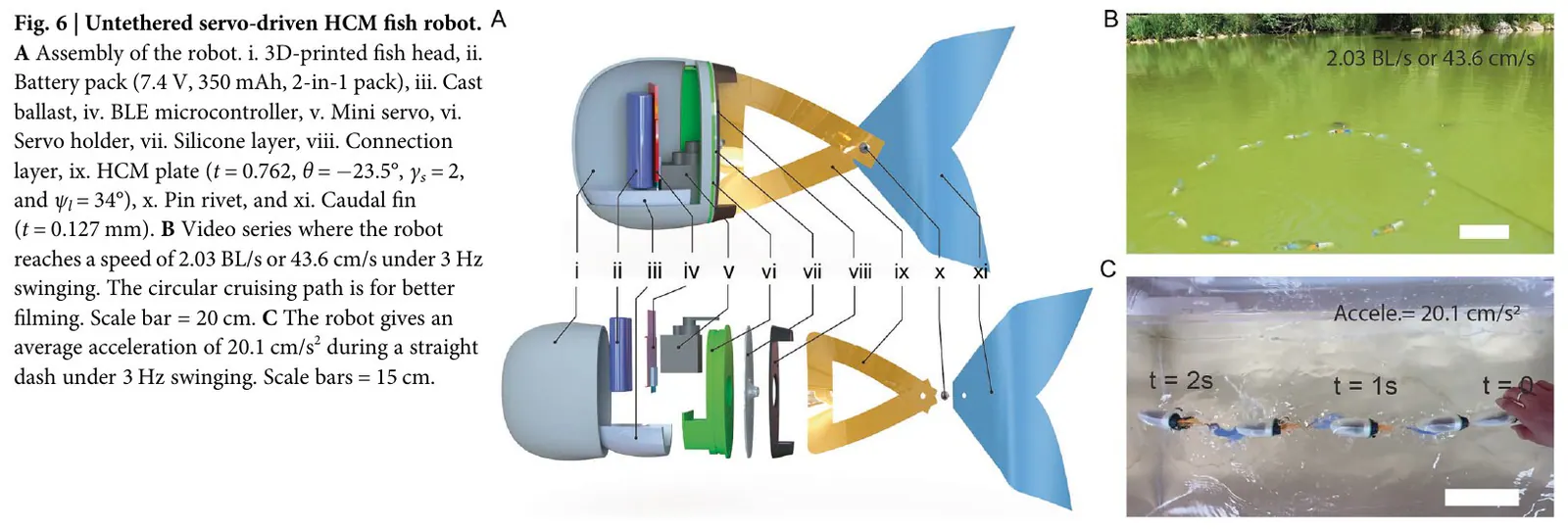
Air-powered robots are tied to a pump. As the paper puts it, untethered robots “usually provide more convincing evidence”. So the second fish carries everything on board: a 7.4 V battery, a Bluetooth microcontroller and one small servo in a 3D-printed head. The servo turns the centre of a thicker clip (0.762 mm PETG) through a silicone seal, and the clip snaps a blue tail fin back and forth. It is 21.5 cm long and weighs 125 g.

Fish two, no longer tied to a pump
Battery, Bluetooth board and one servo, all on board. Next stop: an actual lake.
Out in a lake, running at 3 tail beats per second (six snaps), it swam 554 cm in 12.7 seconds: 43.6 cm/s, or 2.03 body lengths per second. It swam in a circle on purpose, steered by putting slightly more weight on one side, to keep it in the camera frame. In a straight dash it accelerated at about 20 cm/s². And, a lovely detail: local fish chased it, then fled when it touched them.
Thrust at 3 Hz, its best setting. Peak was 250.31 mN at 3.5 Hz.
Energy efficiency: how much electrical power becomes useful thrust work.
Cost of transport: energy used per unit weight per distance. Lower is better.
One thing the paper mentions only in passing matters a lot for a real swimmer: plastic clips crack. The team’s earlier work found that a 0.381 mm plastic clip survives roughly 20,000 actuation cycles before it fails. At several snaps a second, that number runs out quickly.

The clip, somewhere around snap 19,999
About 20,000 cycles is plenty for a demo. A fish meant to swim for days would need a tougher clip, or a different material.
3 tail beats per second: about 1.9 h of swimming
At the lake-test setting, 20,000 tail beats go by in under two hours (under one if every snap counts). Fine for a demo, short for a real mission.
05
How fast is “fast”?
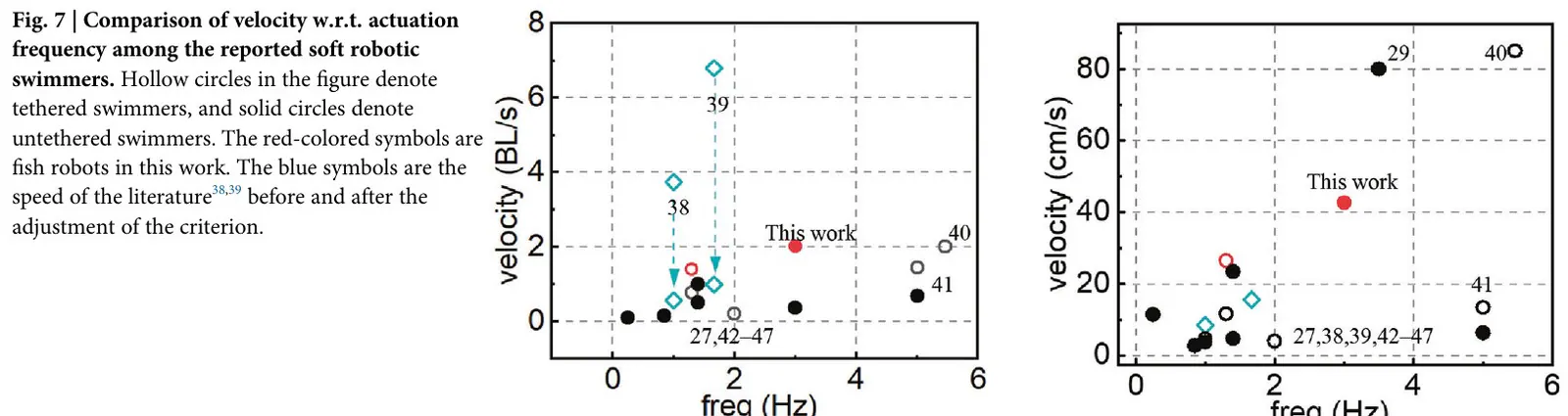
The paper says its untethered fish is among the fastest soft robot fish, and 40% faster than the previous record holder among untethered ones (1.45 BL/s). That is true in body lengths per second. But robot fish are measured in two ways, and they don’t agree.
Per body length: second in the table
Measured by its own length, the untethered hair clip fish is beaten only by Zhang et al.’s manta-ray robot (2.22 BL/s) in this table, and it is 40% ahead of Chao et al., the previous untethered record the paper cites.
Per body length, the hair clip fish is near the top. In plain centimetres per second, two robots in the same table are faster. Both statements are true, which is exactly why speed claims need their ruler stated.

Every soft-robot speed record
Body lengths per second flatter small robots; centimetres per second flatter big ones. Pick the ruler and you can often pick the winner.
06
It matters? How?
Most fast robot fish either beat their tails very quickly with stiff mechanisms, or need high voltages, pumps or exotic materials. This one gets a natural-looking, fast tail stroke from a cut plastic sheet, a rivet and a single hobby servo. That is cheap, easy to build, and easy to repair.
The bigger contribution is the design rule. Because the clip’s shape depends only on two numbers, not on material or size, engineers can pick a kink angle and leg ratio from a chart, then build in whatever material and scale suits the job. Snapping structures could make many soft robots faster, from grippers to crawlers, and the same group has already used elastic snaps for both.
The catches
Comparisons: the snapping and conventional fish aren’t built the same way (the authors say so), so the 2× result mixes the effect of snapping with the effect of geometry. The thrust explanation (faster flicks, thrust growing with speed squared) is a hypothesis, not tested. On efficiency, at least one robot in the paper’s own table has a much lower cost of transport (1.24 vs 5.14).
Measurements: the headline speed comes from one filmed lap in a lake, with no repeat runs or error bars reported. How speed changes with tail-beat frequency wasn’t measured, because the tank was too small. Steering is open loop, and the circle came from deliberately unbalanced weights.
Durability and details: plastic clips crack after roughly 20,000 cycles, only one to two hours of swimming at 3 Hz if the thicker clip lasts as long, and the paper doesn’t test it. The abstract gives the speed as 42.6 cm/s while the results give 43.6 cm/s; the distance and time (554 cm in 12.7 s) support 43.6. And a stiff plastic ribbon driven by a servo is “soft” in a fairly generous sense.
07
TLDR?
How to turn a hair clip into a fish...
- 1Pin the feet of a kinked ribbon together and it buckles into a clip with two stable shapes and an energy hill between them.
- 2Push slowly and it snaps across in tens of milliseconds, releasing stored energy as a wave down its length, much like a fish’s body wave.
- 3The clip’s resting shape depends only on its kink angle and leg ratio, so one design scales to any size or material.
- 4As a fish’s body, snapping doubled speed over a conventional twin, and a one-servo version swam 2.03 body lengths per second in a lake.
- 5Fast per body length; less dominant in cm/s or efficiency. And plastic clips may wear out within hours.
08
Personal Take
I love papers that start from something everyone owns. Everyone has snapped a hair clip without thinking about it, and here it becomes a design principle with an equation behind it. The part I find most useful isn’t the fish at all. It is the result that the clip’s shape depends only on two numbers. That turns a fiddly, trial-and-error part into something you can look up on a chart and scale, and that is how a trick becomes a tool.
I also appreciate how honest the authors are about the limits: the theory is “still qualitative”, the comparison fish isn’t a perfect match, and they even show how changing the definition of body length can shrink an impressive-sounding speed. That honesty is also why I would hold the “among the fastest” claim a little loosely. The best result rests on one filmed lap, and the ranking changes depending on the ruler.
What I would want to see next is simple and slightly boring. A conventional fish built the same way, so the snap is the only difference. Several runs at several frequencies, with error bars. A long test to see how many hours a clip actually survives in water. And a fish that steers itself instead of swimming the circle its ballast chooses. If the clip still wins after all that, it deserves a place in every soft robot designer’s toolbox.
← Back to all talksDiscussion
Comments
Register with your email to join the discussion
No comments yet. Be the first to share your thoughts.